Farm Business
Farm Insurance for Growers: A Plain-Spoken Guide to Coverage That Actually Protects the Farm
Learn how farm insurance for growers covers property, liability, crops, revenue, and mistakes to avoid when choosing protection.

Published July 18, 2026 · 13 min read
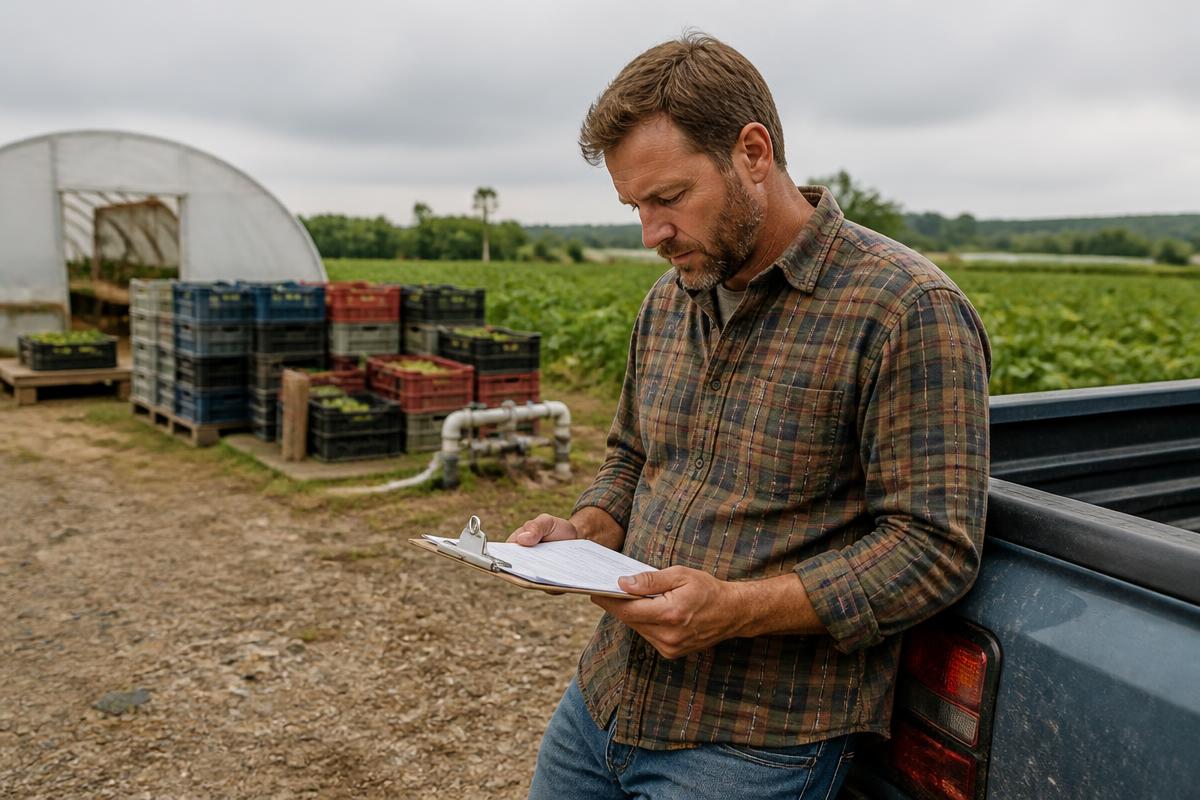
Farm insurance for growers is not one policy. It is a risk-management plan built from several pieces: property, liability, crop coverage, vehicle coverage, workers’ compensation, and sometimes whole-farm revenue protection. The right mix depends on what you grow, where you sell, how much equipment you own, whether customers visit the farm, and how much income the farm must protect. A five-acre market garden with a roadside stand does not need the same package as a 900-acre grain operation, but both need to know exactly what is covered before a fire, storm, injury, theft, pesticide drift claim, or crop failure happens.
Why Farm Insurance Matters
Growers work with thin margins and expensive assets. A single refrigerated box truck, compact tractor, wash-pack line, high tunnel, or irrigation well can represent years of profit. Weather risk is also rising. USDA Risk Management Agency data show that federal crop insurance pays billions of dollars in indemnities in difficult production years, with drought, excess moisture, freeze, hail, and wind among the most common loss drivers. At the same time, direct-market growers face risks that traditional commodity farms may not: customers walking across uneven ground, volunteers using tools, chefs buying greens, CSA members picking up shares, or agritourism guests entering barns and fields.
Insurance cannot make a bad business model profitable. It also cannot replace good maintenance, written food-safety procedures, employee training, or common sense. What it can do is keep one bad day from becoming the end of the farm. The practical goal is simple: identify the losses you could not comfortably pay for out of pocket, then transfer part of that risk to an insurer at a reasonable cost.
Property Coverage
Farm property insurance covers physical assets. Typical covered property may include barns, sheds, greenhouses, hoop houses if listed, irrigation pumps, tractors, implements, tools, harvested crops in storage, packing equipment, refrigeration units, office equipment, and sometimes fencing or signs. The policy may be written as part of a farm package policy or as separate inland marine, equipment, or building coverage.
What property insurance actually covers depends on the form. A named-perils policy covers only listed causes of loss, such as fire, lightning, windstorm, hail, theft, vandalism, or collision. A special-perils or open-perils form is broader and covers direct physical loss unless the policy excludes it. Common exclusions include wear and tear, rust, mechanical breakdown, flood, earth movement, pest damage, poor maintenance, intentional acts, and sometimes collapse from snow load unless specifically included.
Valuation matters as much as the coverage itself. Replacement cost coverage pays to replace damaged property with similar new property, subject to policy terms. Actual cash value pays replacement cost minus depreciation. For a 12-year-old walk-in cooler, actual cash value may be far below what it costs to install a new unit. Equipment may need to be scheduled item by item with serial numbers and values. If a $45,000 tractor is not listed, or is listed at $25,000 because the schedule was never updated, the claim may disappoint you.
Practical example: A diversified vegetable farm loses a packing shed to an electrical fire. The shed contains a barrel washer, stainless tables, harvest bins, scales, labels, a walk-in cooler compressor, and $18,000 of packed produce. If the policy only lists the building and tractor, the farm may receive payment for the structure but little or nothing for business personal property or refrigerated inventory. A better policy would separately cover the building, contents, produce in storage, equipment breakdown, and extra expense to rent temporary cold storage.
Growers should also ask about mobile equipment. Tractors and implements are often used on rented fields, public roads, farmers market sites, or neighboring farms. Coverage that applies only at the insured premises may not be enough. Inland marine coverage can protect movable equipment wherever it is normally used.
Liability Coverage
Farm liability insurance protects against claims that the farm caused bodily injury, property damage, or certain personal and advertising injuries. It can pay for legal defense, settlements, and judgments up to policy limits. For growers, liability coverage is not optional if the farm sells food, hires labor, leases land, drives equipment on roads, hosts visitors, or sells wholesale to stores and restaurants.
Common examples include a CSA member slipping on ice during pickup, a child injured during a pumpkin patch event, a tractor damaging a neighbor’s fence, spray drift harming adjacent crops, or a customer alleging illness from contaminated produce. General farm liability may respond to some of these, but not all. Product liability, premises liability, completed operations, chemical drift liability, agritourism endorsements, and umbrella liability may need to be reviewed separately.
Product liability is especially important for growers selling fresh produce, value-added foods, eggs, meat, dairy, or nursery stock. Many grocery stores, food hubs, school districts, and restaurants require proof of insurance, often with $1 million per occurrence and $2 million aggregate limits as a baseline. Larger buyers may require higher limits, additional insured status, or specific wording on certificates.
Workers’ compensation is another area where farms get into trouble. Rules vary by state, but farms with employees may be required to carry workers’ compensation once they exceed a labor, payroll, or employee-count threshold. Even when not required, medical and wage-loss claims from a harvest injury can be large. Do not assume that calling someone an intern, volunteer, contractor, or apprentice eliminates responsibility. If the person is working under your direction with farm tools, exposure may exist.
Vehicle liability also deserves attention. A personal auto policy may not cover regular farm deliveries, employee drivers, produce hauling, or a truck registered to the farm business. If you drive to farmers markets, deliver CSA boxes, haul livestock, or tow equipment, discuss commercial auto or farm truck coverage with an agent.
Crop Insurance
Crop insurance protects against production or revenue losses from approved causes such as drought, excess moisture, freeze, hail, wind, disease, insects, or market-price changes, depending on the policy and crop. In the United States, many policies are federally subsidized and sold by approved insurance providers under the USDA Risk Management Agency. Deadlines are strict. Sales closing, acreage reporting, production reporting, and notice-of-loss dates must be met.
Traditional multi-peril crop insurance is common for major row crops such as corn, soybeans, wheat, cotton, and rice. Some fruit, nut, nursery, forage, and specialty crops also have policies in certain counties. Coverage may be based on actual production history, county yields, revenue protection, or other approved methods. Growers choose coverage levels, often from 50% to 85% of approved yield or revenue. Higher coverage costs more but leaves less risk on the farm.
Hail coverage is usually separate and can be useful where hail is a major localized threat. Unlike drought, which can affect an entire region, hail can destroy one farm while the neighbor is untouched. Private crop-hail policies often allow flexible limits and may be purchased in addition to federal crop insurance.
Practical example: A melon grower in a county with an eligible policy insures 40 acres based on actual production history. A late-season flood prevents harvest from half the acreage. If excess moisture and prevented harvest are covered, and notice is filed correctly, the policy may pay an indemnity based on the covered production shortfall. But if acreage was underreported, records are missing, or the grower destroys the crop before an adjuster inspects it, payment may be reduced or denied.
Not every crop in every county has a standard policy. Smaller diversified growers should ask about written agreements, Noninsured Crop Disaster Assistance Program options through the Farm Service Agency, and Whole-Farm Revenue Protection. The key is to start early. Waiting until the forecast turns bad is too late.
Whole-Farm Revenue Protection
Whole-Farm Revenue Protection, often called WFRP, is designed to protect the revenue of the entire farm rather than one crop at a time. It can be especially useful for diversified growers, organic farms, CSAs, market gardeners, farms selling through multiple channels, and operations with crops that lack individual crop policies. Coverage is based largely on historical farm revenue reported on tax records, adjusted for the current year’s expected revenue.
WFRP can cover revenue from many commodities, including fruits, vegetables, livestock, nursery crops, and value-added products if they meet program rules. It generally rewards diversification because a farm with multiple commodities may qualify for better coverage terms than a farm depending on one product. Coverage levels may be available up to 85% for sufficiently diversified farms.
What does it actually cover? WFRP protects against an insured revenue shortfall caused by unavoidable natural causes and market fluctuations during the insurance year, subject to policy rules. It does not simply guarantee profit. It does not cover poor management, lack of a market, failure to follow good farming practices, or undocumented cash sales. It also requires strong records: Schedule F or other farm tax forms, inventory records, sales records, and production plans.
Practical example: A 12-acre organic market farm grows salad greens, tomatoes, carrots, flowers, and winter squash. It sells through CSA shares, farmers markets, and two restaurants. After an unusually wet spring, early plantings fail, market sales drop, and total farm revenue ends the year 30% below the approved insured amount. If the farm purchased WFRP, kept accurate records, and the cause of loss is covered, the policy may pay based on the revenue shortfall after required calculations. Without WFRP, the farm might have no crop-specific protection for several of those crops.
WFRP is paperwork-heavy compared with simple property coverage. For farms with clean books, diversified sales, and meaningful revenue at risk, it can be worth the effort. For farms with incomplete records or mostly personal-use production, it may not fit.
How to Choose Coverage
Choosing farm insurance starts with a written risk inventory. Do not begin with the cheapest premium. Begin with the question, “What loss could put us out of business?” Then work backward.
- List assets. Include buildings, greenhouses, high tunnels, tractors, implements, irrigation systems, wells, coolers, wash-pack equipment, tools, computers, inventory, seed, fertilizer, and stored crops. Assign current replacement values.
- Map activities. Note farmers markets, CSA pickups, wholesale delivery, agritourism, U-pick, school visits, workshops, custom work, pesticide application, livestock, employees, volunteers, and rented land.
- Identify income streams. Break down gross revenue by crop, market channel, season, and buyer. This helps determine whether crop insurance, WFRP, or business income coverage is relevant.
- Check legal and contract requirements. Lenders, landlords, farmers markets, food hubs, grocery stores, and government leases may require specific limits or certificates.
- Choose deductibles intentionally. A higher deductible can reduce premiums, but only if the farm has cash reserves to absorb that amount after a loss.
- Compare exclusions, not just price. Two policies with the same premium can differ sharply on equipment breakdown, theft, pollution, farm product liability, hired labor, and off-premises coverage.
- Use farm-experienced advisors. Work with an insurance agent who understands agriculture and, for crop insurance, an approved crop insurance specialist familiar with your county and crop mix.
A useful rule: insure the risks that are low-frequency but high-severity. You may be able to self-insure a broken hand tool or a few lost market crates. You probably cannot self-insure a barn fire, serious customer injury, employee accident, crop failure, or lawsuit from a foodborne illness allegation.
Common Mistakes
Mistake 1: Assuming a homeowner policy covers the farm. Homeowner policies usually exclude or severely limit business farming activity. A small garden that sells $500 of produce may be treated differently from a full commercial operation, but you need written confirmation. If customers, employees, or business inventory are involved, homeowner coverage is rarely enough.
Mistake 2: Underinsuring buildings and equipment. Construction costs, steel prices, electrical work, refrigeration, and machinery values have risen sharply in many regions. A barn insured for its value 10 years ago may be far below replacement cost today.
Mistake 3: Forgetting new enterprises. Insurance bought for field vegetables may not automatically cover a cider press, farm dinners, goat yoga, cut-flower weddings, delivery vans, or commercial kitchen activity. New income streams often create new liability exposures.
Mistake 4: Missing crop insurance deadlines. Crop insurance is deadline-driven. Sales closing dates can arrive months before planting. Acreage reports, production records, and notices of loss must be submitted on time.
Mistake 5: Poor records. Insurance claims depend on proof. Keep receipts, equipment serial numbers, photos, planting records, yield records, spray logs, harvest logs, invoices, payroll records, market deposits, and tax returns. Cloud storage plus paper backups is better than one notebook in the truck.
Mistake 6: Buying limits that satisfy a market but not the farm’s real risk. A farmers market may require $1 million liability, but a serious injury or product claim can exceed that. Umbrella coverage is often a cost-effective way to add higher limits.
Mistake 7: Not reading exclusions. Flood, pollution, communicable disease, pesticide drift, employee injury, contract liability, and agritourism activities may be limited or excluded unless endorsed.
Annual Review Checklist
Farm insurance should be reviewed at least once a year and whenever the farm changes. Good review times are before policy renewal, before crop insurance sales closing dates, and before launching a new enterprise. Bring your agent a current asset list, revenue by enterprise, payroll estimates, vehicle list, lease agreements, buyer insurance requirements, and any planned construction or events.
Ask direct questions: Are my high tunnels covered for wind and snow? Is produce in the cooler covered after harvest? Are employees, interns, and volunteers handled correctly? Does liability apply at farmers markets and CSA pickup sites? Are delivery drivers covered? Is pesticide drift excluded? Do I have business income or extra expense coverage if a fire shuts down the wash-pack area? Would flood require a separate policy? Do my crop policies match actual planted acres and practices?
Finally, treat insurance as one layer of resilience. Pair it with emergency savings, safe equipment operation, food-safety systems, written employee training, diversified markets, sound contracts, and good agronomy. The best insurance strategy is not the biggest stack of policies. It is coverage matched to the farm’s real assets, real hazards, and real income. When you understand what each policy does and does not cover, you can buy protection with confidence instead of fear.
Key takeaways
- ◆Farm insurance should be built around your actual risks: land, buildings, equipment, crops, employees, customers, vehicles, and income streams.
- ◆Property coverage protects physical assets, but exclusions, valuation method, deductibles, and item schedules determine what you are really paid after a loss.
- ◆Liability insurance is essential for farms that sell food, host visitors, employ workers, lease land, or operate equipment near public roads.
- ◆Crop insurance and Whole-Farm Revenue Protection can help stabilize income, but deadlines, records, approved causes of loss, and coverage levels matter.
- ◆The biggest mistakes are underinsuring, assuming a homeowner policy covers farm activity, missing crop insurance dates, and failing to update coverage as the farm grows.
Frequently asked questions
What types of insurance do growers usually need?+
Most growers should review farm property, general liability, product liability, vehicle coverage, workers’ compensation if they have labor, and crop or whole-farm revenue protection. The right package depends on farm size, crops, sales channels, employees, visitors, equipment, and lender or buyer requirements.
Does farm property insurance cover high tunnels and greenhouses?+
Only if the policy includes them. Some policies exclude or limit coverage for fabric-covered structures, collapse, wind, or snow load. High tunnels, greenhouses, irrigation, fans, heaters, and benches should be listed with realistic replacement values and reviewed for exclusions.
Is crop insurance only for large commodity farms?+
No. Traditional policies are common for major commodity crops, but many specialty crops have coverage in certain counties. Diversified farms may also consider Whole-Farm Revenue Protection or disaster assistance options. Eligibility, deadlines, and record requirements vary.
What is the difference between liability and product liability?+
General liability often covers bodily injury or property damage from farm premises or operations. Product liability addresses claims that a farm product, such as produce or value-added food, caused harm after sale. Growers selling food should confirm product liability is included.
How often should a farm insurance policy be updated?+
At least annually and anytime the farm adds equipment, buildings, employees, vehicles, markets, agritourism, value-added processing, rented land, or new crops. Coverage that fit last season may be inadequate after expansion.
Keywords
- farm insurance for growers
- farm liability insurance
- crop insurance
- whole-farm revenue protection
- farm property insurance
- farm risk management
- agricultural insurance policies
Related reading

Farm Business
Farm Financing: How to Actually Get Your First Farm Loan Approved
USDA FSA, Farm Credit and community banks all lend to first-time farmers, but each wants a different story. Here is the paperwork, the ratios and the pitch that actually closes a farm loan in 2026.
July 18, 2026 · 13 min read
Farm Business
Direct-Marketing Beef: The Half-Cow CSA Model That Sells Out Every Year
A working cattle producer's playbook for direct-marketing beef by the half — pricing, processor logistics, customer acquisition and the margin math that beats the auction barn by 3–5×.
July 16, 2026 · 13 min read

Farm Business
The Farm Business Plan: What the First Five Years Actually Cost
An honest, working-farm walk-through of the financials most new farm business plans get wrong — startup costs, cash-flow gaps, breakeven timing and the numbers lenders actually want to see.
July 11, 2026 · 11 min read