Homesteading
Beekeeping on the Small Farm: A Complete First-Season Guide
Hive costs, siting, package versus nuc, the inspection calendar, varroa management and honest first-year honey expectations — a working grower's guide to your first season of beekeeping.

Published August 3, 2026 · 8 min read
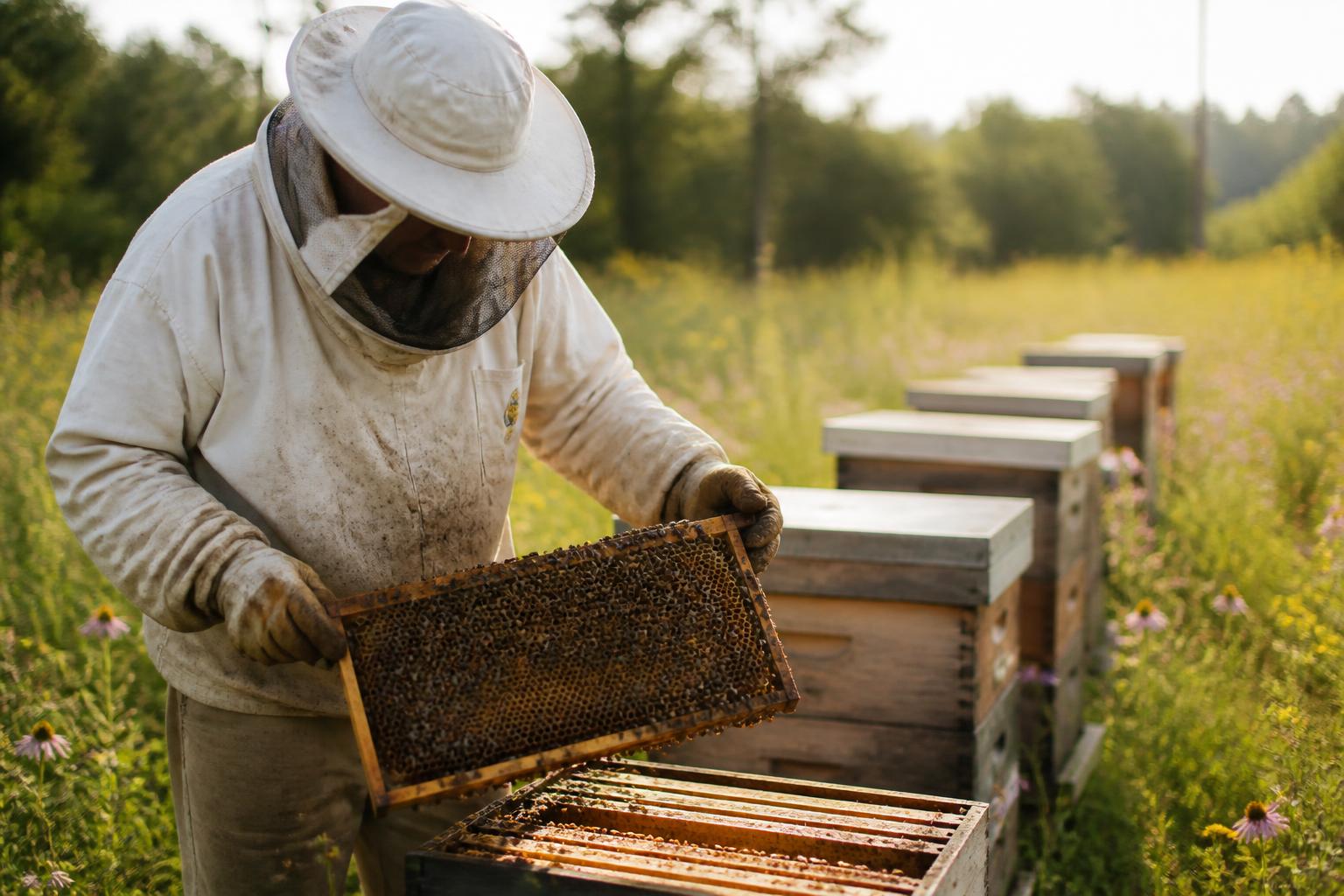
Two hives will do more for a diversified small farm than almost any other thousand-dollar investment. They pollinate the orchard and the cucurbits, they turn hedgerow bloom that had no market value into a product you can sell at $12 a pint, and they force you to pay closer attention to what is flowering on your ground than you ever did before. They will also die on you the first winter if you treat them like livestock that manage themselves.
This guide covers a realistic first season: the money, the equipment, the calendar, and the single management task \u2014 varroa mite control \u2014 that separates beekeepers who still have bees in April from those who do not.
Why Bees Earn Their Keep on a Small Farm
The honey is the least interesting part of the return. On a diversified operation, the value stacks in three layers.
- Pollination. Cucumbers, summer squash, melons, blueberries and tree fruit all show measurable yield and fruit-quality gains with reliable pollinator pressure. A single strong colony forages a two-mile radius, which covers essentially every block on a farm under 100 acres.
- A high-margin retail product. Raw local honey sells at farm stands and markets for $10\u2013$16 per pint with no processing infrastructure beyond an extractor and a strainer. Two productive hives in year two can put 60\u2013100 lb of surplus honey in jars.
- Customer draw. Honey is the item that gets a customer to stop at the stand. Attach a photograph of your hives to the label and it stops being a commodity.
Set the expectation now: in year one you should plan on harvesting nothing. A package installed in April spends its whole first season drawing comb and building population. Comb is expensive for bees to make \u2014 roughly eight pounds of honey consumed per pound of wax produced \u2014 and a colony that enters winter light on stores dies in February. Leave it all on the hive.
What a First Hive Actually Costs
Beekeeping is cheap to try and expensive to do badly. Here is a realistic 2026 budget for two hives, which is the correct starting number \u2014 two colonies let you compare a struggling hive against a healthy one and let you steal a frame of brood from the strong to rescue the weak.
| Item | Cost (two hives) | Notes |
|---|---|---|
| Hive bodies, bottom boards, covers | $400\u2013$520 | Two deeps plus two mediums each |
| Frames and foundation | $180\u2013$240 | Buy assembled if your time is worth anything |
| Bees (packages or nucs) | $320\u2013$500 | Nucs cost more and are worth it |
| Suit, gloves, smoker, hive tool | $180\u2013$260 | Buy a full suit, not a jacket, the first year |
| Feeder and sugar | $60\u2013$90 | Budget 40\u201350 lb of sugar per colony, year one |
| Varroa treatment and monitoring | $70\u2013$110 | Alcohol wash jar plus two treatments |
| First-season total | $1,210\u2013$1,720 | Extractor deferred to year two |
Skip the extractor until you have honey worth extracting. Most county beekeeping associations own one and lend it to members for a nominal fee, which is one of several reasons to join before you buy a single box.
Siting the Apiary
Bees are less fussy than the forums suggest, but four site factors genuinely matter.
Morning sun, afternoon shade. East-facing entrances get the colony foraging an hour earlier. In climates that run above 90°F in July, afternoon shade saves the workers from spending the whole afternoon fanning and hauling water instead of nectar.
Dry footing and a windbreak. Never site hives in a frost pocket or a spot that puddles. A hedgerow, barn wall or stacked round bales on the prevailing-wind side dramatically improves overwintering survival.
Water within 100 yards. If you do not provide water, the bees will use your neighbor's pool or your livestock trough. A shallow pan with gravel or floating cork, refilled reliably from the day you install, sets the habit early.
Flight-path management. Point entrances away from footpaths, and put a five-foot fence or shrub row eight feet in front of the hives. The bees climb over it and cross human traffic at head height and above, which eliminates most stings and most complaints.
Set hives on stands 16\u201318 inches off the ground. Your back will thank you, skunks will be discouraged, and the bottom board stays out of wet grass.
Package, Nuc or Swarm?
Three ways to get bees, with very different first-year outcomes.
A package is three pounds of shaken bees plus a caged, unrelated queen \u2014 roughly $130\u2013$180. It is the cheapest option and the slowest to establish. The colony has no comb, no brood and no stores, and must accept a queen it has never met. Packages are fine in long-season climates with an early flow.
A nucleus colony (nuc) is five frames of drawn comb with brood in all stages, food, workers and a laying queen already accepted \u2014 typically $180\u2013$250. A nuc is three to five weeks ahead of a package on installation day. For a first-year beekeeper in a northern climate, that head start is often the difference between a colony that overwinters and one that does not. Buy nucs, and buy them locally from an overwintered northern source rather than from a package shipper in the Deep South.
A caught swarm is free and unpredictable. Swarms come with unknown genetics, an unknown mite load and an unknown queen age. Get on your county association's swarm list in year two, not year one.
The First-Season Inspection Calendar
New beekeepers open hives too often, which chills brood and sets the colony back a day each time. Work to a schedule instead.
Installation week. Install in the evening. Feed 1:1 sugar syrup immediately and keep feeding continuously until the bees stop taking it or the main flow starts. Do not open the hive again for seven days beyond confirming the queen has been released.
Weeks 2\u20136: every 7\u201310 days. You are answering one question \u2014 is the queen laying? Look for eggs (a single white grain standing upright at the base of a cell) rather than hunting the queen herself. Eggs mean a queen was present within three days. Check that the brood pattern is solid rather than spotty, and that they are drawing comb outward from the center.
Weeks 7\u201312: every 10\u201314 days. Add a box when the bees have drawn and occupied roughly seven of ten frames in the current one. Adding too early gives wax moths and small hive beetles undefended space; adding too late triggers swarm preparation. From late May, check the bottom bars of frames for swarm cells every inspection.
August through September. Focus shifts entirely to winter preparation: mite counts, feeding, and assessing stores. Stop opening hives in earnest once night temperatures drop into the 40s.
Keep a written record for each hive \u2014 date, temperature, eggs seen, frames of brood, boxes on, treatment applied. In your second season those notes are worth more than any book.
Varroa: The Thing That Kills Your Bees
Varroa destructor is a parasitic mite that feeds on developing and adult bees and vectors deformed wing virus and acute paralysis virus. It is the proximate cause of the large majority of colony losses in North America. Cold does not kill colonies; colonies weakened by mite-vectored virus fail to cluster properly and then cold finishes them.
Two rules cover nearly all of first-year mite management.
Rule one: measure, do not guess. Perform an alcohol wash \u2014 half a cup of bees, roughly 300 individuals, shaken from a brood frame into alcohol \u2014 monthly from June onward. Count the mites that drop. Above three mites per hundred bees going into fall, the colony is on a trajectory to fail. Sugar rolls are gentler on the bees but consistently undercount; sticky boards are the least reliable of the three.
Rule two: treat in late summer, before the winter bees are raised. The bees that carry a colony through winter are reared in late August and September. If those bees develop while mite loads are high, they emerge with shortened lifespans and the cluster dwindles in January regardless of how much honey sits above it. Treating in November is treating a colony that is already lost.
Pick a treatment appropriate to your temperatures and whether honey supers are on: formic acid pads work through brood cappings but need a temperature window; oxalic acid dribble or vapor is highly effective but only during broodless periods; thymol-based products sit between the two. Read the label, follow the temperature range exactly, and rotate chemistry between years to avoid resistance.
Getting the Colony Through Winter
Heft the back of the hive in October. A colony ready for winter in a northern climate feels immovably heavy \u2014 roughly 60\u201390 lb of stores depending on latitude; 40\u201350 lb is adequate in the mid-South. If it lifts easily, feed heavy 2:1 syrup until the bees stop taking it, then switch to fondant or a sugar brick placed directly over the cluster once it turns cold, since bees cannot process liquid syrup below about 50°F.
Beyond stores, three things matter: an upper entrance or ventilation notch so moisture escapes rather than condensing on the lid and dripping onto the cluster; a mouse guard on the lower entrance installed before the first hard frost; and a wind block. Cold, dry bees survive. Wet bees do not. Resist wrapping hives in plastic without a moisture path \u2014 it is condensation, not temperature, that kills.
The Five Mistakes Beginners Repeat
- Harvesting honey in year one. The bees need every ounce. Patience in year one buys a real harvest in year two.
- Skipping mite monitoring. A colony can look strong in September and be dead in January. Only a mite count tells you which one you have.
- Inspecting too often. Every opening costs the colony roughly a day of work. Stick to the calendar.
- Starting with a single hive. With one colony you have no baseline and no resources to rescue it. Start with two.
- Stopping feeding too early. A colony that has not yet drawn out its brood boxes still needs syrup, whatever the calendar says.
Join the county association before your bees arrive, find one experienced local keeper willing to stand at your hives for an afternoon, and register your apiary with your state department of agriculture where required \u2014 registration is often free and it means the inspector calls you before pesticide applications nearby.
The Honest Timeline
Year one you buy equipment, learn to read frames, and keep bees alive. Year two, if both colonies overwinter, you take 40\u201380 lb of honey and split a strong hive to make a third colony at no cost. Year three you are producing surplus reliably and the pollination benefit across the farm is visible in your cucurbit and tree-fruit numbers. That is the real return curve, and it is worth planning around rather than being surprised by.
Key takeaways
- ◆Budget $1,200–$1,700 for two hives in year one; defer the extractor until year two.
- ◆Buy locally sourced nucs rather than shipped packages — the head start is worth the price difference.
- ◆Harvest no honey in the first season; the colony needs every pound to overwinter.
- ◆Monitor varroa monthly with an alcohol wash and treat before late-August winter-bee rearing.
- ◆Winter losses are caused by moisture and mites far more often than by cold itself.
Frequently asked questions
How much honey will I get in the first year?+
Plan on none. A first-year colony spends the season drawing comb and building population, and needs 40–90 lb of stores to overwinter depending on your climate. Harvesting in year one is the most common cause of first-winter colony loss.
Should I start with a package or a nucleus colony?+
A nuc, if you can source one locally. It arrives with drawn comb, brood in all stages and an accepted laying queen, putting it three to five weeks ahead of a package — usually the margin between overwintering and dying.
How many hives should a beginner start with?+
Two. A single colony gives you no baseline for comparison and no way to rescue a failing hive with a frame of brood. Two hives roughly double the odds you still have bees the following spring.
Do I have to treat for varroa mites?+
In practice, yes. Untreated colonies in most of North America accumulate mite loads that vector deformed wing virus into the winter bees and collapse the cluster by mid-winter. Monitor monthly with an alcohol wash and treat before late-August winter-bee rearing.
How far do honey bees travel from the hive?+
Foragers typically work within a two-mile radius, covering roughly 8,000 acres. That means one apiary pollinates every block on a small farm, but it also means you cannot control the pesticide exposure of most of their forage.
Keywords
- beekeeping for beginners
- how to start beekeeping
- first year beekeeping
- varroa mite treatment
- langstroth hive setup
- small farm pollination
Related reading

Homesteading
Hugelkultur: Raised Beds That Feed Themselves
Learn the secrets of Hugelkultur, a permaculture technique for building self-fertilizing, water-retaining raised beds using buried wood.
July 19, 2026 · 7 min read

Regenerative Farming
Pollinator Strips That Pay: Habitat, Yield and the ROI Nobody Talks About
Pollinator strips aren't charity — a well-designed one raises yield on the crop next to it. A field-tested guide to species mix, placement, cost and the real return on investment.
July 13, 2026 · 12 min read
Homesteading
Starting a Backyard Homestead: The Realistic First Year
A grounded, non-romantic guide to your first year of homesteading — what actually works on a quarter-acre, in what order, and where new homesteaders most often burn out.
July 5, 2026 · 9 min read