Homesteading
Planting a Small Orchard: Rootstocks, Spacing and the First Five Years
Fruit trees are a decade-long decision made in a single afternoon. A working guide to rootstock choice, site and spacing, planting technique, training systems, pest management and what a small orchard actually earns.

Published September 1, 2026 · 12 min read
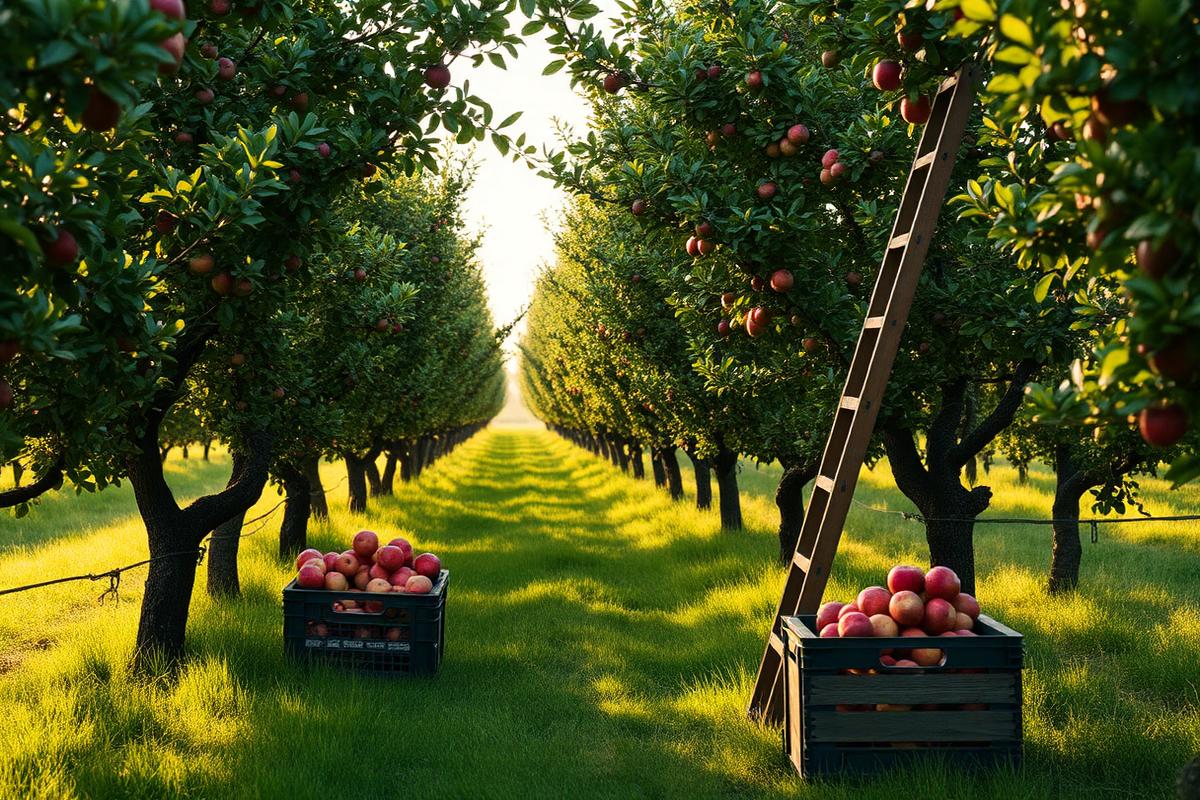
An orchard is the only crop on the farm where the decisions you make in one afternoon govern the next twenty-five years. Vegetables forgive you every season. A badly rootstocked, badly spaced block of fruit trees compounds its mistakes annually, and by the time it is obvious, you have lost half a decade. The good news is that the decisions are few and knowable.
Reading the site before you buy trees
Fruit trees need three things the catalogue will not sell you: drainage, air movement and light. Standing water for more than a day after heavy rain means Phytophthora root rot, and no rootstock survives it indefinitely. Dig a test hole 60 cm deep, fill it with water, and time how long it takes to drain. Anything beyond four to six hours means you plant on berms or you plant elsewhere.
Air drainage is the quieter failure. Cold air flows downhill and pools in hollows, and a frost pocket will strip blossom in one night during a late-April cold snap. A gentle slope with an open bottom end is worth more than perfect soil on flat ground. Avoid planting immediately below a solid hedge or wall that dams cold air.
Light is non-negotiable: full sun, at minimum six hours in the growing season, ideally eight. Shaded trees make wood instead of fruit, and the fruit they do make lacks sugar and colour.
Soil chemistry is the easiest of the four to fix. Test before planting and aim for pH 6.0–6.8, moderate phosphorus and potassium, and organic matter above 3%. Lime takes months to move pH through the profile, so a soil test twelve months before planting is not excessive planning — it is the normal timeline.
Rootstock is the whole decision
Almost every fruit tree sold is two plants: a scion variety grafted onto a rootstock that controls final size, precocity, anchorage and a good deal of disease tolerance. Choose the rootstock first and the variety second.
For apples, the workable range on a small farm:
- M27 (very dwarf, ~1.5–2 m). Fruits in year two, needs permanent staking and irrigation, will not compete with grass. Suits container growing and intensive beds, little else.
- M9 (dwarf, ~2–2.5 m). The commercial intensive standard. Very precocious, heavy yields per hectare, brittle roots that require a trellis or post for life.
- M26 (semi-dwarf, ~2.5–3 m). A fair compromise for a home or market block: fruit by year three, still needs early staking, manageable from the ground.
- MM106 (semi-vigorous, ~3.5–4.5 m). Self-supporting on good soils, tolerant of woolly aphid, the default for a grassed orchard with mixed grazing beneath. Susceptible to collar rot on wet ground.
- M25 or seedling (standard, 6 m+). Longevity of fifty years or more, ladder work forever, first serious crop in year six to eight. The right choice for a legacy planting or a grazed traditional orchard, the wrong one for cash flow.
Pears follow a similar logic on Quince A and Quince C; stone fruit uses Saint Julien A for semi-dwarf plums and Gisela series for cherries, where dwarfing rootstock finally made netting against birds practical.
The rule of thumb: the more dwarfing the rootstock, the earlier and more reliably it fruits, and the more support, water and weed-free ground it demands in return. Dwarf trees are not low-maintenance trees. They are high-yield trees with a shorter wait.
Choosing varieties and pollination
Buy for your climate and your market, not for nostalgia. Check chill-hour requirements against your region — a variety needing 1,000 chill hours planted in a mild coastal zone will bloom erratically and crop poorly for its entire life. Check disease resistance too: scab-resistant apple varieties such as Liberty, Enterprise or Topaz will save you four to eight sprays a year compared with a scab-prone heirloom.
Almost all apples and pears are self-incompatible, which means at least two varieties with overlapping bloom periods must be planted within about 20 m of each other. Nursery catalogues list flowering groups from 1 (earliest) to 7; pick from the same group or adjacent ones. Beware triploid varieties such as Bramley or Jonagold — they produce sterile pollen and require two other compatible varieties nearby, not one.
Spread ripening dates deliberately. A block that all ripens in the third week of September creates a labour crisis and a glut. Early, mid and late season varieties in roughly equal thirds turn a two-week panic into a ten-week harvest.
Layout, spacing and support
Spacing follows rootstock. As a working guide: M9 at 1–1.2 m in-row on a trellis with 3.5 m alleys; M26 at 2.5 m with 4 m alleys; MM106 at 4 m with 5 m alleys; standards at 7–9 m each way. Alleys must be wide enough for whatever machine you actually own, plus a margin — measure your mower and add a metre.
Orient rows north to south where the ground allows, so both sides of the canopy receive direct light across the day. On a slope, run rows along the contour instead; erosion control beats a marginal light gain.
Dwarf and semi-dwarf plantings need support installed before the trees, not after. End posts at 2.5 m driven 80 cm deep, braced, with two or three wires at 0.8 m, 1.5 m and 2.1 m. Retrofitting a trellis into an established row means damaging roots you spent three years growing.
Planting technique that matters
Plant bare-root stock in dormancy — late autumn where winters are mild, late winter where they are hard. Bare-root establishes faster and costs a third of containerised stock.
Dig a hole wide but no deeper than the root system. A deep hole invites settling, and settling buries the graft union. The graft union must sit 8–10 cm above the finished soil level, permanently. If soil or mulch covers it, the scion roots and the dwarfing effect disappears — the single most common orchard-killing error made by careful people.
Do not amend the planting hole with compost or fertiliser. Rich backfill encourages roots to circle inside the hole rather than exploring the surrounding soil. Backfill with the soil you removed, firm it with your heel, water in thoroughly to settle air pockets, then mulch a one-metre circle to a depth of 8 cm — keeping the mulch a hand's width clear of the trunk.
Guard against rabbits and voles with a spiral or mesh guard from day one, and against deer with a fence or individual cages if you have them. A single winter of vole girdling under snow ends a tree silently.
Training and pruning, years one to five
Two systems cover nearly all small-orchard needs. Central leader — a single dominant vertical stem with tiers of scaffold branches — suits apples and pears on semi-dwarf and dwarf stock. Open centre or vase — three to five main limbs and no leader — suits peaches, plums and apricots, which fruit on younger wood and need light in the middle.
Year one: head the whip at 80–90 cm to force branching, remove nothing else. Year two: select three or four scaffolds with wide angles, spaced around the trunk, and spread narrow crotches to 45–60 degrees with clothes pegs or limb spreaders. Wide angles carry fruit; narrow angles split under load. Year three: choose a second tier of scaffolds 60 cm above the first, remove competing leaders, thin crossing wood. Years four and five: shift from structural cuts to renewal pruning, removing the oldest fruiting wood each winter to keep young, productive spurs coming.
Prune in late winter while dormant for structure; prune in summer to slow excess vigour and admit light to ripening fruit. Never remove more than about a quarter of the canopy in one dormant season — hard pruning provokes a forest of watersprouts, which is the tree telling you it has been over-cut.
Thin the fruit, ruthlessly. Six weeks after bloom, reduce clusters to a single fruit every 15–20 cm along the branch. Unthinned trees produce small, poorly coloured fruit, exhaust themselves and fall into biennial bearing — a heavy year followed by nothing — which takes three seasons to correct.
Pest and disease management
Sanitation does more than spraying. Rake and remove fallen leaves in autumn to break the apple-scab cycle, collect and destroy dropped fruit to interrupt codling moth, and cut out cankered wood in dry weather. Mow the alleys but leave a flowering strip at the headland for parasitic wasps and hoverflies.
Monitor rather than calendar-spray. Pheromone traps for codling moth tell you when the flight begins so a single well-timed intervention replaces four blind ones. Sticky red-sphere traps track apple maggot. A dormant-season horticultural oil application smothers overwintering mites and scale and is the highest-value spray of the year on most small blocks.
Fireblight in apples and pears is a bacterial disease that runs down shoots in warm, wet bloom weather. Cut affected wood 30 cm below visible damage, disinfect the saw between cuts, and avoid heavy nitrogen, which pushes the soft growth the bacterium enters through.
What a small orchard earns
A quarter-acre of apples on MM106 at 4 m spacing holds roughly 60 trees. Establishment costs run near $18 per tree for stock, guards and stakes, plus ground prep and mulch — call it $1,600 for the block. Mature yield at 40–60 kg per tree gives 2,400–3,600 kg. At a farm-gate $2.50 per kg, that is $6,000–$9,000 gross, from a block that takes perhaps 60 hours a year of pruning, thinning and harvest once established.
The catch is time. There is no meaningful revenue before year three, and no full crop before year six. Orchards are best planted alongside an annual enterprise that pays the bills while the trees grow, and they pay back hardest when the fruit is sold direct, pressed into juice or cider, or dried, rather than dropped into a wholesale bin at commodity price.
Plant fewer trees than you want and manage them properly. Twenty well-pruned, well-thinned trees will out-earn eighty neglected ones, and they will still be productive when your children are pruning them.
Key takeaways
- ◆Choose the rootstock before the variety - it controls size, precocity, support needs and lifespan.
- ◆Keep the graft union 8-10 cm above soil level permanently; burying it destroys the dwarfing effect.
- ◆Install trellis or stakes before planting dwarf and semi-dwarf trees, not afterwards.
- ◆Train to a central leader for apples and pears, open centre for stone fruit, and spread narrow crotch angles early.
- ◆Thin fruit six weeks after bloom to prevent small fruit and biennial bearing.
Frequently asked questions
How long until fruit trees produce fruit?+
It depends almost entirely on rootstock. Dwarf stock like M9 or M26 gives a first crop in years two to three; semi-vigorous MM106 in years three to four; standard seedling rootstock takes six to eight years.
How far apart should fruit trees be planted?+
Match spacing to rootstock: about 1 metre in-row for M9 on a trellis, 2.5 metres for M26, 4 metres for MM106 and 7-9 metres for standard trees, with alleys wide enough for your mower plus a margin.
Do I need two fruit trees to get fruit?+
For apples and pears, yes - nearly all are self-incompatible and need a second compatible variety flowering at the same time within about 20 metres. Most peaches, apricots and sour cherries are self-fertile.
Why is my fruit small and poorly coloured?+
Usually the tree has set too much fruit. Thin clusters to one fruit every 15-20 centimetres about six weeks after bloom; unthinned trees also fall into biennial bearing.
Keywords
- planting a small orchard
- apple rootstock guide
- fruit tree spacing
- orchard pruning first years
- small farm fruit trees
Related reading

Regenerative Farming
Pollinator Strips That Pay: Habitat, Yield and the ROI Nobody Talks About
Pollinator strips aren't charity — a well-designed one raises yield on the crop next to it. A field-tested guide to species mix, placement, cost and the real return on investment.
July 13, 2026 · 12 min read
Homesteading
Starting a Backyard Homestead: The Realistic First Year
A grounded, non-romantic guide to your first year of homesteading — what actually works on a quarter-acre, in what order, and where new homesteaders most often burn out.
July 5, 2026 · 9 min read
Soil Health
Building Healthy Soil: A Practical, Working-Farm Guide
How real farms build living, productive soil — a field-tested guide to soil biology, organic matter, cover crops and testing you can actually use this season.
May 14, 2026 · 12 min read