Market Gardening
Starting a Market Garden on a Tight Budget: A First-Year Plan That Can Actually Cash-Flow
Start a profitable market garden on a tight budget with first-year costs, hand tools, crop plans, sales channels, and cash-flow targets.

Published July 18, 2026 · 13 min read
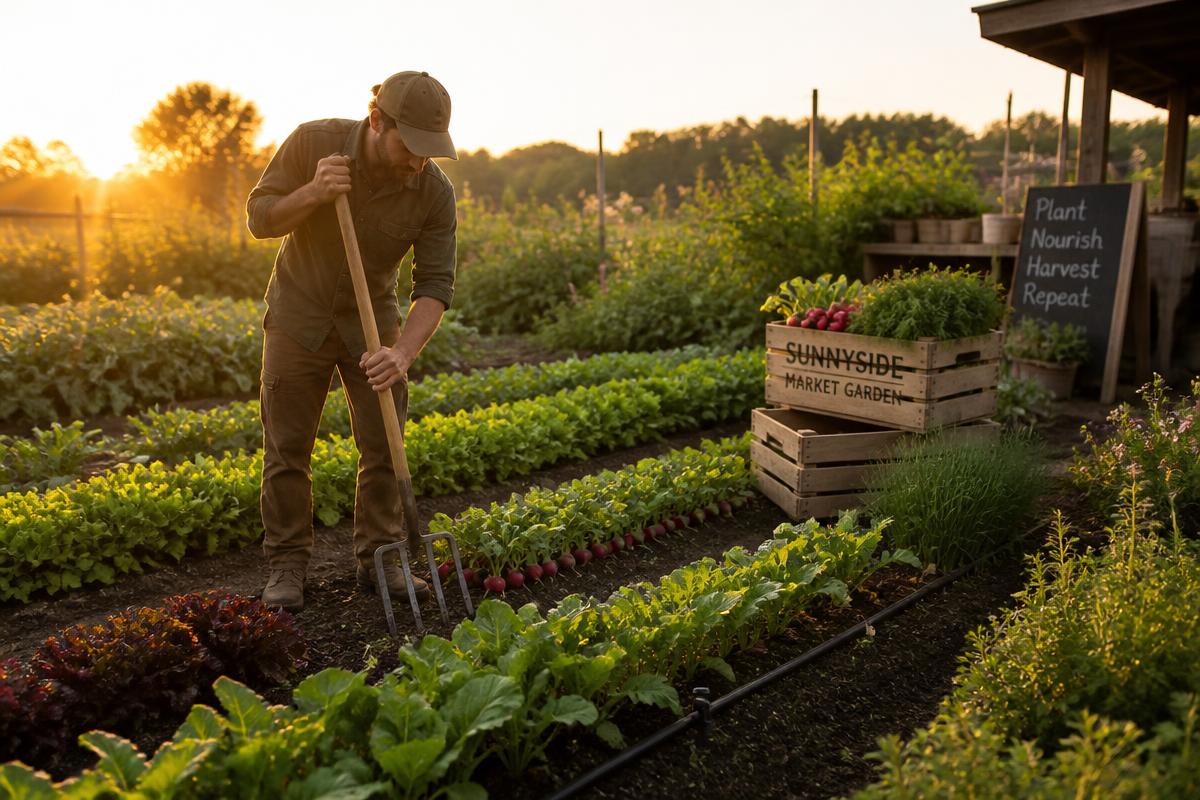
Starting a market garden on a tight budget is possible, but only if you treat it like a small production business from day one—not like a big backyard garden with a cash box. The goal in year one is not to buy every clever tool, grow every crop, or rent five acres. The goal is to build a repeatable system on a small plot, sell before you overproduce, and keep enough cash moving to pay for seed, compost, packaging, market fees, and your own learning curve. A lean market garden can begin with hand tools, permanent beds, basic irrigation, and direct sales. It will not be effortless. It can, however, be practical, measurable, and profitable enough to justify year two.
Start Small Enough to Finish Well
The cheapest market garden is the one you can manage cleanly. For most first-year growers, that means starting with 1/8 to 1/4 acre in production. On paper, an acre sounds more profitable. In real life, an acre of vegetables can become an acre of weeds, pests, half-finished irrigation, and unsold produce if you are undercapitalized.
A strong beginner layout is 25 to 40 permanent beds, each 30 inches wide and 50 feet long, with 12- to 18-inch paths. That gives you roughly 3,125 to 5,000 square feet of actual growing space. If you have more land available, cover it with tarp, mow it, or plant a cover crop. Do not plant it all just because it is there.
Permanent beds save money because they reduce tillage, simplify crop planning, and let you standardize seed orders, row cover, irrigation, and harvest estimates. A 50-foot bed is easy to measure: if you seed four rows of radishes, you know how many bunches to expect; if you transplant kale at 12-inch spacing in two rows, you can estimate plant count quickly. Standardization is one of the most underrated tools in low budget farming.
Before spending money, confirm three things: sunlight, water, and market access. You need at least 8 hours of full sun, reliable water close to the field, and customers within a practical delivery or market radius. Cheap land with no water is expensive land. Beautiful soil two hours from buyers is a hobby plot, not a business location.
Practical First-Year Startup Costs
Market garden startup costs vary widely, but a tight-budget grower should build a written startup list before buying anything. The numbers below assume you already have access to a small piece of land and a vehicle. If you need to buy land, drill a well, or purchase a delivery van, this is a different financial model.
- Soil test: $25 to $75. Do this first. Guessing at fertility wastes money.
- Compost and amendments: $500 to $1,500. Bulk compost is usually cheaper than bagged. Lime, organic fertilizer, gypsum, or trace minerals should follow soil test recommendations.
- Seeds and transplants: $300 to $900. Start with fewer varieties and multiple successions.
- Basic irrigation: $300 to $1,200. Drip tape, header line, filter, pressure regulator, fittings, and hoses.
- Hand tools: $700 to $1,800. Buy durable essentials, not gimmicks.
- Propagation setup: $250 to $1,000. Trays, soil blocks or plug trays, potting mix, heat mat, lights or simple greenhouse space.
- Wash and pack setup: $300 to $1,200. Tables, bins, food-safe totes, salad spinner or washing screens, scale, sprayer, shade.
- Packaging and labels: $150 to $600. Bags, twist ties, rubber bands, clamshells, labels, market signs.
- Market fees, licenses, and insurance: $300 to $1,200. Requirements vary by state and sales channel.
- Tarps and row cover: $250 to $900. These are labor-saving tools, not luxuries.
- Website, payment processor, and bookkeeping: $100 to $500. A simple order form and accounting spreadsheet may be enough.
A practical lean startup range is $2,500 to $7,500. The low end requires borrowing, scavenging, and keeping the crop list tight. The high end gives you better irrigation, a functional wash station, and fewer bottlenecks. If your budget is under $2,500, reduce scale further and focus on a microgreen, herb, or salad subscription model before trying to operate a full mixed vegetable farm.
Essential Hand Tools and Supplies
Hand tools are the engine of a small market garden. Spend money where the tool saves hours every week or improves crop quality. A broadfork, for example, can loosen compacted soil without inverting layers. A sharp stirrup hoe can keep a bed clean in minutes if used when weeds are tiny. A push seeder can pay for itself quickly in salad greens, radishes, carrots, and beans.
Start with this essential kit:
- Broadfork: For loosening beds and improving drainage without deep tillage.
- Wheel hoe or stirrup hoe: For fast path and bed-edge weeding.
- Collinear or wire hoe: For shallow, precise weeding in crop rows.
- Quality rake: For bed shaping, seedbed preparation, and smoothing compost.
- Push seeder: For direct-seeded crops. Even an entry-level seeder is better than hand-seeding hundreds of row feet.
- Harvest knives and scissors: Buy several and keep them sharp and clean.
- Harvest bins and totes: Food-safe, stackable containers prevent crushed produce.
- Digital scale: Required for consistent sales by weight and honest yield tracking.
- Tarps: For stale seed bedding, killing cover crop, and holding clean ground.
- Drip irrigation supplies: Water stress ruins yield and quality faster than almost any other problem.
Do not buy a tractor, walk-in cooler, flame weeder, paperpot transplanter, greens harvester, or delivery trailer in the first month unless you have confirmed sales to justify it. Cooling is important, but a used refrigerator, chest freezer with a controller, insulated coolers, and shade can serve a very small first-year operation. Upgrade when spoilage or harvest volume proves the need.
A Small First-Year Crop Plan
A small market garden crop plan should balance speed, reliability, harvest labor, and customer demand. In year one, avoid making your identity depend on difficult crops. Long-season storage onions, sweet corn, melons, and large winter squash can work, but they use space for a long time and often return less per square foot than greens, roots, herbs, and high-turnover vegetables.
For 30 beds at 50 feet each, consider this simple plan:
- 8 beds salad greens: Lettuce mix, arugula, baby kale, mustard mix, spinach in cool seasons. Seed every 1 to 2 weeks.
- 5 beds roots: Radishes, salad turnips, beets, carrots. Use quick crops early and carrots where weed pressure is controlled.
- 4 beds herbs and scallions: Cilantro, dill, parsley, basil, scallions. High value, strong restaurant appeal.
- 4 beds tomatoes and cucumbers: Trellised crops for summer draw and market display. Keep varieties limited.
- 3 beds kale, chard, and collards: Repeated harvest crops for bunches and cooking greens.
- 3 beds summer squash and beans: Productive, familiar crops, but harvest often.
- 3 flexible beds: Succession overflow, flowers, failed crop replacement, or late fall greens.
Here is a realistic spring-to-summer succession example. In March or April, seed radishes, arugula, lettuce mix, and turnips under row cover. Harvest in 25 to 45 days. Replant those beds into a second round of greens or roots. In late May, move some beds into basil, cucumbers, beans, and squash. In late summer, flip tired summer beds back to fall greens, carrots, and turnips.
Track expected revenue by bed. A 50-foot bed of radishes might produce 80 to 150 bunches. At $3 per bunch, gross potential is $240 to $450. A salad mix bed cut once might yield 35 to 60 pounds. At $10 to $14 per pound retail, that is $350 to $840 gross, though harvest and washing labor are significant. Tomatoes can gross well, but trellising, disease, harvest time, and cull rate must be included. The point is not fantasy revenue per acre; it is knowing what each bed must do.
Direct Sales Channels That Fit a Small Plot
Planting without a sales plan is one of the fastest ways to lose money. Direct market sales should begin before seed orders are finalized. A first-year grower needs simple channels with low overhead and fast feedback.
Farmers markets are useful because you meet buyers, learn pricing, and see what sells. The downside is time. A four-hour market can require eight to ten total hours when harvesting, washing, packing, driving, setting up, and breaking down are counted. Choose one good market over three weak ones.
A small CSA can provide early cash. Start with 10 to 20 members, not 75. Offer a simple weekly share for 10 to 14 weeks. Be honest that it is a first-year farm. A small CSA works best when members live nearby and understand seasonal eating.
Restaurants can be excellent for herbs, salad mix, baby roots, edible flowers, and specialty greens. They also demand consistency. Visit chefs with a clean availability sheet, sample product, and clear delivery day. Do not promise 30 pounds of arugula weekly unless your beds and weather can support it.
Farm stand or porch pickup can be the lowest-cost channel if you are near traffic or have a local following. Online preorders reduce waste because you harvest what is already sold. Even a simple weekly list sent by email or text can move produce efficiently.
A balanced first-year sales mix might look like this: one Saturday farmers market, 15 CSA members, two restaurant accounts, and one weekly preorder pickup. That gives you cash in advance, public visibility, wholesale-style repeat sales, and a low-waste local outlet.
Realistic First-Year Cash-Flow Outlook
Cash flow matters more than impressive annual projections. Most market gardens spend heavily before they sell much. Seeds, compost, irrigation, tools, market fees, insurance, and packaging come due early. Revenue often starts small in spring, improves in early summer, peaks midseason, and drops unless fall crops are planned.
For a 1/8 to 1/4 acre first-year garden, a realistic gross sales range is $6,000 to $18,000 if you execute consistently. A strong operator in a good market may exceed that, but beginners should not build a budget on best-case numbers. Net profit might be $1,000 to $7,000 after expenses, and your hourly wage may be low the first year. That is not failure if the infrastructure carries into year two and the customer base grows.
Example lean cash-flow outline:
- January to March expenses: $2,000 to $5,000 for tools, seed, compost, trays, irrigation deposits, insurance, and market fees.
- April sales: $300 to $1,000 from early greens, radishes, plant starts, or CSA deposits.
- May sales: $800 to $2,500 as greens, herbs, roots, and CSA shares begin.
- June to August sales: $1,500 to $4,000 per month with market, CSA, restaurant, and pickup sales.
- September to October sales: $800 to $3,000 per month if fall greens, roots, herbs, and late tomatoes are maintained.
In a modest scenario, the farm spends $5,000 and grosses $10,000, leaving $5,000 before taxes and unpaid owner labor. In a stronger scenario, it spends $7,500 and grosses $18,000, leaving $10,500 before taxes and owner labor. In a weak scenario, it spends $6,000 and grosses $4,500 because of poor sales, drought, weeds, or crop failure. Your job is to protect against the weak scenario by keeping fixed costs low, selling early, and planting reliable successions.
Use a weekly cash-flow sheet with four columns: expected sales, actual sales, expenses paid, and cash on hand. Review it every Sunday. If sales lag, reduce new spending immediately. If a crop fails, replant a fast crop rather than staring at bare ground. If markets are strong, increase successions of proven crops instead of adding ten new varieties.
A Simple Weekly Workflow
A market garden runs on rhythm. Without a weekly routine, urgent work takes over and important work gets missed. A part-time first-year schedule might look like this:
- Monday: Walk beds, update harvest estimates, seed trays, order supplies, send restaurant availability.
- Tuesday: Weed young crops, flip finished beds, transplant or direct seed successions.
- Wednesday: Irrigation check, trellising, pest scouting, wash station cleaning.
- Thursday: Harvest for restaurants or CSA, pack orders, update online preorder list.
- Friday: Main harvest, wash, spin, weigh, label, and load for market.
- Saturday: Farmers market or farm stand, record sales by crop, note customer requests.
- Sunday: Light field check, cash-flow review, rest, and next-week planning.
Recordkeeping does not need to be fancy. Track seed date, bed number, harvest date, yield, sales value, and problems. After one season, those notes become your best consultant. They will tell you which crops earned their space and which ones only looked good in the seed catalog.
Budget Mistakes to Avoid
The most common first-year mistake is buying infrastructure before proving demand. A cooler, tunnel, or tractor can be useful, but debt payments do not care whether it rained, whether the market was slow, or whether deer ate the lettuce. Rent, borrow, improvise, or delay major purchases when possible.
The second mistake is growing too many crops. Diversity is helpful for direct sales, but complexity is costly. Twenty well-managed crops beat sixty neglected ones. Limit varieties within each crop. One red tomato, one cherry tomato, one slicer, and one paste tomato may be enough. Three lettuce types may serve better than twelve.
The third mistake is underpricing. If bunching, washing, bagging, labeling, driving, and standing at market are included, cheap produce is not generous—it is unsustainable. Visit local markets, note prices, and position your farm as fresh, reliable, and local. Do not apologize for charging enough to stay in business.
The fourth mistake is ignoring labor. A bed that grosses $600 but takes 30 hours to seed, weed, harvest, wash, and sell may not be better than a bed that grosses $350 with five hours of labor. Measure dollars per bed and dollars per hour where you can.
Finally, avoid treating year one as a pass-fail test. A tight-budget market garden is a learning season with real money attached. If you finish with reusable tools, better soil, a customer list, accurate records, and a short list of crops that sold well, you have built an asset. Keep the plot small, keep the numbers visible, and let actual sales—not ego—decide how fast the farm grows.
Key takeaways
- ◆Start with 1/8 to 1/4 acre, not more, and focus on fast crops that can be harvested repeatedly or turned quickly.
- ◆A lean first-year market garden can launch for about $2,500 to $7,500 if land access and water are solved cheaply.
- ◆Essential hand tools matter more than machinery: broadfork, hoe, rake, seeder, harvest knife, bins, scale, and wash setup.
- ◆Direct sales through a small CSA, farm stand, restaurants, and one farmers market reduce risk when planned before planting.
- ◆Realistic first-year cash flow is often modest: expect $6,000 to $18,000 gross on a part-time plot, with net profit depending on labor and discipline.
Frequently asked questions
How much land do I need to start a market garden?+
For a tight-budget first year, 1/8 acre to 1/4 acre of intensively managed beds is enough. That can support 25 to 60 permanent 30-inch beds, depending on bed length, and is easier to plant, weed, irrigate, and sell through than a larger plot.
Can I start a market garden without a tractor?+
Yes. Many small market gardens begin without a tractor by using permanent beds, compost, tarps, a broadfork, hand tools, and a push seeder. Machinery can save labor later, but it is not the first purchase for a lean startup.
What crops make money fastest in a small market garden?+
Fast crops such as salad mix, radishes, baby kale, arugula, turnips, scallions, herbs, and summer squash can create early cash flow. The best crops combine short days to maturity, reliable demand, manageable harvest labor, and good price per bed foot.
How much can a first-year market garden earn?+
A realistic part-time first year might gross $6,000 to $18,000 on 1/8 to 1/4 acre, assuming strong direct sales and consistent production. Net profit can be much lower after tools, compost, irrigation, packaging, market fees, insurance, and fuel.
Should I sell at farmers markets or start a CSA first?+
If you already have a customer list, a small CSA provides early-season cash. If not, a farmers market or farm stand helps you meet buyers and test pricing. Many first-year growers combine a 10 to 20 member CSA with one weekly market and a few restaurant accounts.
Keywords
- starting a market garden on a tight budget
- market garden startup costs
- small market garden crop plan
- low budget farming
- direct market sales
- hand tools for market gardening
- first year farm cash flow
Related reading
Market Gardening
Season Extension: Building a Caterpillar Tunnel That Pays Back in One Year
A working market gardener's guide to specifying, building and cropping a caterpillar tunnel — with real numbers on materials, labor, winter greens revenue and year-one payback.
July 15, 2026 · 13 min read

Farm Business
The Farm Business Plan: What the First Five Years Actually Cost
An honest, working-farm walk-through of the financials most new farm business plans get wrong — startup costs, cash-flow gaps, breakeven timing and the numbers lenders actually want to see.
July 11, 2026 · 11 min read
Market Gardening
Market Gardening: The First-Year Mistakes That Cost the Most
The pattern of expensive mistakes new market gardeners make in year one — and the small planning decisions that separate a viable second season from a shut-down.
July 1, 2026 · 8 min read