Market Gardening
Drip Irrigation for Small Vegetable Farms: Design, Installation and Scheduling
Drip irrigation cuts water use by half and doubles uniformity. A complete working guide to sizing mainlines, choosing tape, filtration, pressure zones, fertigation and irrigation scheduling for small vegetable farms.

Published September 2, 2026 · 11 min read
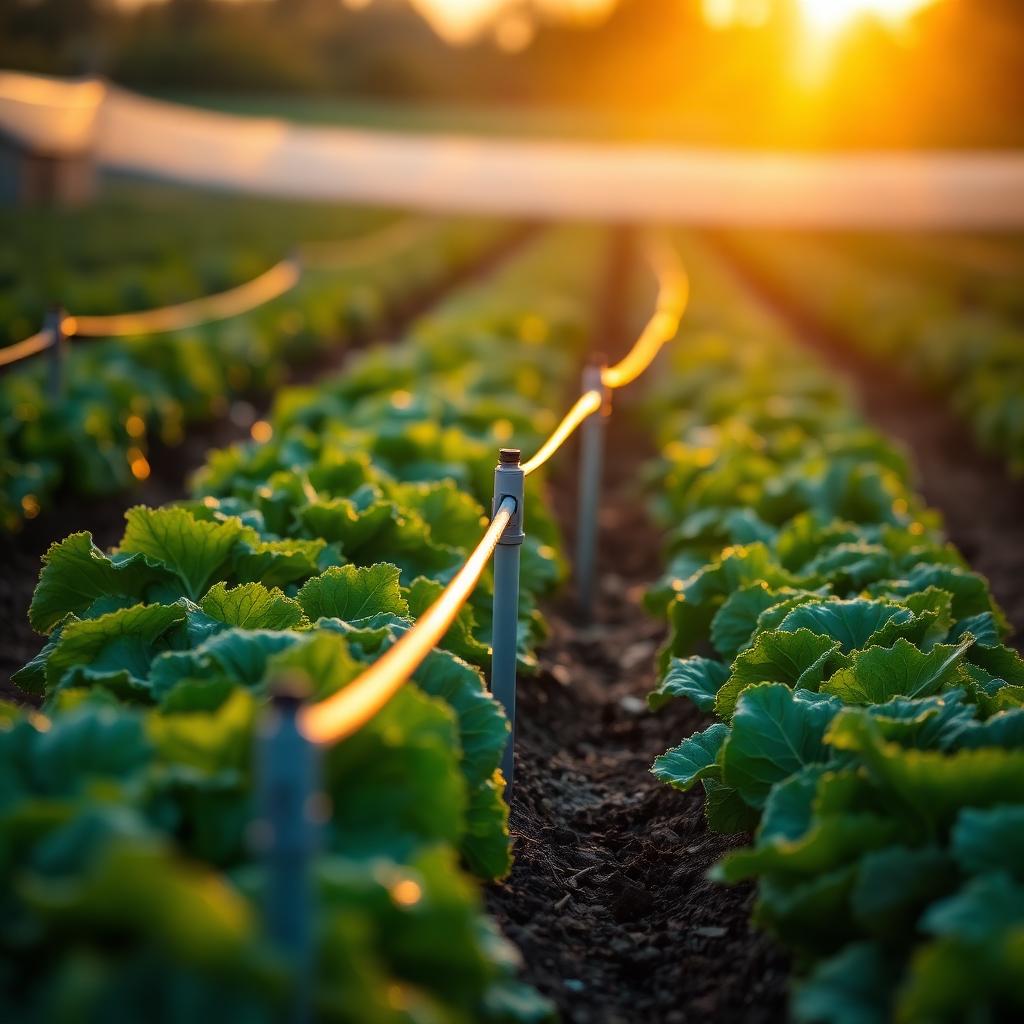
A well-designed drip system is the closest thing vegetable farming has to a free lunch. It halves water use compared with overhead sprinklers, puts moisture in the root zone instead of on foliage, suppresses foliar disease, and turns fertiliser from a broadcast guess into a precisely metered feed. It is also one of the most commonly botched installations on small farms - usually because someone skipped filtration or ignored pressure.
Why drip beats sprinklers
Overhead sprinklers are simple and cheap per metre, and they are the right tool for germinating direct-seeded carrots or settling a newly transplanted bed. Beyond that they lose badly. Sprinkler efficiency in field conditions runs 60-75% once you account for wind drift and evaporation; drip runs 90-95%. Wet foliage invites early blight, septoria and downy mildew - all of which need leaf wetness to infect. And sprinklers water the whole alley, growing weeds you will later hoe, while drip waters only the crop row.
The hidden benefit is uniformity. On a flat bed with matched emitters and correct pressure, every plant receives nearly the same dose. Uniform water means uniform maturity, and uniform maturity means one harvest pass instead of three.
Know your water source first
Design starts at the pump, not at the field. You need three numbers: available flow in litres per minute, sustained pressure in bar, and water quality from a laboratory test. A drip system that needs 60 L/min fed by a well that delivers 40 will either starve the far end of every zone or force you to split the field into smaller zones - a cheap fix if you plan it, an expensive one if you discover it in July.
Flow demand is simple arithmetic. A standard 15-mil drip tape at 30 cm emitter spacing delivers roughly 2.5-3.5 L per minute per 100 metres of tape at 0.6 bar. Ten 100-metre runs open simultaneously is about 30 L/min before friction losses in the mainline. Write the number down before you buy anything.
The lab test matters for chemistry, not safety: high iron precipitates inside emitters, high bicarbonate raises pH and forms scale, and suspended solids clog everything. A $40 water test tells you which filters and which acid treatment, if any, you need.
Filtration is not optional
Every drip failure story begins the same way: a farmer connected tape to an unfiltered line and spent August poking emitters with a wire. Emitters have openings of about 0.5-1 mm. Sand, algae, insect eggs and pipe scale will find them.
For clean well water, a 120-mesh screen filter is adequate and cheap - under $40 for a unit handling 80 L/min. For surface water from ponds, rivers or canals, you need a disc filter or a sand-media filter upstream, because algae and organic slime pass through screens and regrow inside the tape. Flush screen filters weekly; install a pressure gauge either side and clean when the differential rises by 0.3-0.5 bar.
Add a pressure regulator after the filter, sized for the zone flow, and a pressure gauge at the head and at the far end of the longest run. The gauge at the far end is the instrument that tells you the truth about your whole system.
Sizing mainlines and zones
The rule that governs everything: pressure variation across a zone must stay under about 20%, or uniformity collapses. That means the mainline must be fat enough that friction loss along it is small. Layflat poly mainline is the small-farm standard because it is cheap, rollable and repairable with a knife and a coupler. As a working guide, 2-inch layflat carries about 100-150 L/min comfortably over 50 metres; 3-inch carries double that. When in doubt, go up a size - oversized pipe only costs money once, undersized pipe costs yield every season.
Split the field into zones no larger than your water source can supply at uniform pressure, and group crops with similar water needs in the same zone. Salad greens and celery are thirsty and shallow-rooted; established tomatoes and squash tolerate deeper, less frequent irrigation. A valve manifold with one manual or electric valve per zone lets you schedule them differently.
Keep individual tape runs under 100 metres for standard tape on flat ground, and under 60-80 metres on slopes. Longer runs lose too much pressure at the far end; the first emitter delivers noticeably more than the last, and the crop shows it as a gradient in plant size.
Choosing drip tape
Drip tape is specified by wall thickness in mils (thousandths of an inch), emitter spacing and flow rate. The decision tree is short:
- 8-mil tape. Single season, annual vegetables, careful handling. The budget standard for market gardens; pull it up in autumn.
- 15-mil tape. Two to four seasons, tolerates rougher soils and mechanical cultivation nearby. The right default for most small farms.
- 25-mil or heavier. Semi-permanent installations, perennial beds, rocky soil.
Emitter spacing should match crop spacing and soil type: 20-30 cm for most vegetables on loam, closer (10-15 cm) on sand where water moves straight down rather than sideways, wider on heavy clay where the wetting pattern spreads. Lower-flow emitters (0.4-0.6 L/hr) run longer sets with less deep percolation on light soils; higher-flow emitters (1.0 L/hr) shorten run time on clay.
Run tape emitter-side up to reduce sediment settling into outlets, and anchor ends firmly - a kinked or flapping line wears through at fittings.
Fertigation basics
Once water moves through a controlled pipe network, fertiliser can move with it. A simple Venturi injector costing $15-25, or a proportional injector for more precision, draws stock solution into the mainline. The advantages are real: spoon-feeding nitrogen and potassium weekly matches supply to crop demand, cuts total fertiliser use by a third, and eliminates broadcasting on beds you cannot reach once the canopy closes.
Use fully soluble fertilisers only - standard granular blends leave residue that plugs emitters. Calcium nitrate, potassium nitrate, monopotassium phosphate and urea are the workhorses. Never mix calcium with phosphate or sulphate concentrates in the same stock tank; they precipitate instantly. Always inject downstream of the filter so any precipitate is caught, and flush the system with clean water for 15 minutes after every injection.
Install a backflow preventer between the injector and the water source. In most jurisdictions it is not a suggestion - fertiliser siphoned back into a well is both a legal and a groundwater problem.
Scheduling that works
The most common scheduling error is running the system briefly every day. Shallow, frequent watering keeps roots in the top few centimetres where they bake in heat and compete with weeds. The goal is to wet the full root zone, then wait until the upper soil dries before watering again.
As a starting schedule for established vegetables on loam in summer: 1.5-2.5 hours per irrigation, two to three times per week, adjusted by feel. Dig a hole beside the tape a day after irrigating: the soil should be moist to 25-30 cm. If it is dry at 15 cm, run longer; if it is saturated at 40 cm, run less. On sand, irrigate more often for shorter periods; on clay, less often for longer.
Water early in the morning. Pressure is highest when municipal or well demand is lowest, evaporation loss is minimal, and any foliage that does get wet dries quickly. A $20 battery timer at each zone valve converts scheduling from a chore you skip on busy days into infrastructure that runs itself.
Maintenance and winter storage
Three habits keep a drip system alive for years. First, flush every line monthly during the season: open the ends and run until the water runs clear - the black string of sediment that comes out is what would have become your August clogging problem. Second, walk the lines weekly looking for geysers, chewed tape and dry spots. Third, at season's end, flush thoroughly, drain everything that can hold water, and either lift thin tape for disposal or roll heavier tape onto a reel. Rodents nest in drained tape left on the surface, and one winter of mouse damage opens fifty leaks.
Keep a repair kit by the manifold: spare tape, couplers, goof plugs, a punch and a knife. A leak fixed in five minutes in June is a dead row avoided in July.
A quarter-acre market garden with a filtered 2-inch mainline, four zones and forty runs of 15-mil tape costs roughly $600-900 in parts and a weekend to install. It returns that investment the first dry summer, in water, in weeds not grown and in the blight that never took hold.
Key takeaways
- ◆Size zones to your water source: know flow, pressure and water chemistry before buying parts.
- ◆Filtration is non-negotiable - 120-mesh screen for wells, disc or media filters for surface water.
- ◆Keep pressure variation under 20% across a zone by oversizing mainlines and limiting tape runs to 100 metres.
- ◆Water deeply and infrequently: moist to 25-30 cm, then let the surface dry before the next set.
- ◆Flush lines monthly, fertigate through a filtered injector, and drain the system before winter.
Frequently asked questions
How much does drip irrigation cost for a small farm?+
A quarter-acre vegetable block with layflat mainline, filtration and 15-mil tape runs roughly $600-900 in parts. Per-acre systems with automated valves typically cost $1,200-2,000 installed DIY.
How long should I run drip irrigation on vegetables?+
On loam, 1.5-2.5 hours two to three times per week is a good starting point for established crops. Dig beside a line a day later - soil should be moist at 25-30 cm depth. Sandy soils need shorter, more frequent runs.
What filter do I need for drip irrigation?+
A 120-mesh screen filter is enough for clean well water. Surface water from ponds or canals needs a disc or sand-media filter because algae and organic slime pass through screens.
How long does drip tape last?+
8-mil tape lasts one season; 15-mil lasts two to four seasons with care; 25-mil and heavier can serve semi-permanently. Flush lines monthly and drain everything before winter to get the full lifespan.
Keywords
- drip irrigation for vegetable farms
- drip tape installation
- irrigation scheduling vegetables
- farm irrigation design
- fertigation through drip lines
Related reading
Soil Health
Composting on a Working Farm: Systems That Actually Scale
Backyard piles do not translate to farm scale. A working agronomist's guide to windrow composting, C:N ratios, temperature management, and turning finished compost into a real soil-health tool.
July 12, 2026 · 12 min read
Market Gardening
Market Gardening: The First-Year Mistakes That Cost the Most
The pattern of expensive mistakes new market gardeners make in year one — and the small planning decisions that separate a viable second season from a shut-down.
July 1, 2026 · 8 min read
Soil Health
Building Healthy Soil: A Practical, Working-Farm Guide
How real farms build living, productive soil — a field-tested guide to soil biology, organic matter, cover crops and testing you can actually use this season.
May 14, 2026 · 12 min read