Market Gardening
Greenhouse Tomatoes: Building a Profitable Protected-Cropping Block
Variety choice, grafting, drip fertigation, pruning to a single leader, climate control and honest per-plant economics for growers building a profitable greenhouse tomato block.

Published August 5, 2026 · 8 min read
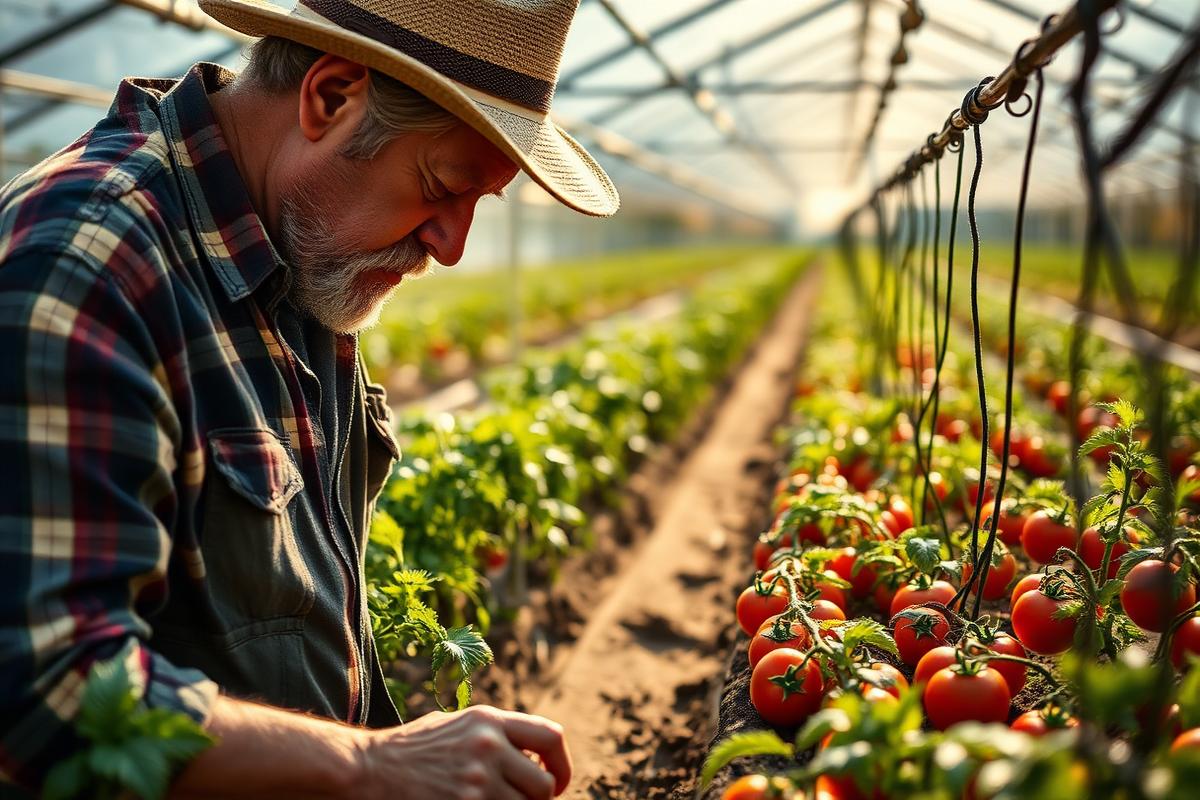
A tomato grown under plastic is a different crop from a tomato grown in the open field. It ripens three to five weeks earlier, it keeps producing until frost rather than collapsing in the first August blight, and it reaches the customer without a rain-split shoulder. On most small farms the protected tomato block is the single highest-revenue square footage on the property, and it is also the block most likely to be managed badly.
This guide walks the whole cycle for a 30 x 96 ft house planted to indeterminate slicers: structure, variety, root zone, pruning, climate and the numbers that decide whether the block pays for itself in one season or three.
Why Protected Tomatoes Beat Field Tomatoes
Three advantages compound. The first is season length. A tunnel planted in late April in a zone 6 climate begins picking in late June and runs to mid-October, roughly doubling the harvest window against a field crop. The second is disease pressure. Early blight, septoria and bacterial spot all move on splashing water; a roof plus drip irrigation removes the transmission mechanism, and fungicide spend typically drops by two-thirds. The third is fruit quality. No rain on ripening fruit means no cracking, no soil splash and a pack-out rate that routinely runs above 90 percent against 60 to 70 percent in the field.
Yield tells the same story. Field slicers on a well-managed farm return 8 to 12 lb per plant. The same variety, grafted, single-leader trained and fertigated under plastic, returns 18 to 25 lb per plant. You are not growing the same crop twice as well; you are growing a fundamentally more productive one.
Choosing the Structure
For a first protected block, a gothic-arch high tunnel with roll-up sides is the right answer almost every time. A 30 x 96 ft gothic kit runs $9,000 to $14,000 in 2026 depending on gauge and wind rating, plus a weekend of labor for a crew of four. The gothic peak sheds snow where a quonset shape will not, and the extra headroom matters enormously when you are training plants to eight feet.
Three decisions to get right at build time, because they are expensive to change later:
- Orientation. Run the long axis north-south in most temperate climates so both sides of the crop rows get direct sun through the day. East-west orientation is only preferable at high latitudes where low winter sun angles dominate.
- Ventilation capacity. Roll-up sides alone are not enough above 90°F. Add ridge vents or, at minimum, hinged end-wall panels. Vent area should equal roughly 20 percent of floor area.
- Trellis anchoring. A mature tomato row loaded with fruit exerts serious downward force. Hang trellis wire from purlins rated for the load, or set independent posts. Do not hang from the plastic-supporting bows alone.
Skip heat in year one unless you are chasing a genuinely early market. Unheated season extension captures most of the margin at a fraction of the capital and operating cost.
Varieties and Grafting
Choose indeterminate varieties bred for protected culture. Determinates set their whole crop in a three-week window and then quit, which wastes the structure. Reliable performers include Geronimo and Trust for red beefsteaks, Rebelski where you want a long harvest with clean shoulders, and Sungold, Esterina or Toronjina for cherries at the premium end of the price sheet. Heirlooms sell well but crack more and yield less; keep them under 20 percent of the planting.
Graft the block. Grafting a productive scion onto a vigorous rootstock such as Maxifort or Estamino is the highest-return decision available to a protected tomato grower. Grafted plants show 20 to 40 percent yield gains, resist soil-borne fusarium, verticillium and corky root rot, and carry a heavier fruit load without stalling. Grafted transplants cost $2.50 to $4.00 each against $0.60 for a seedling, which sounds punishing until you divide it across 20 lb of fruit.
Grafting matters more each year you replant the same ground. A protected house is a monoculture that never rotates; soil pathogens accumulate, and the rootstock is your insurance policy.
Soil, Drip and Fertigation
Test the soil before planting and correct pH to 6.2 to 6.8. Because the roof excludes rain, salts from fertilizer accumulate in the top few inches; monitor electrical conductivity, and once each winter open the house and irrigate heavily, or leave the plastic off a bay, to leach the profile.
Lay two lines of drip tape per bed under landscape fabric or straw mulch. Tomatoes want steady moisture; the wet-dry cycling that causes blossom-end rot and fruit cracking is a calcium-transport problem driven by irregular watering far more often than by actual calcium deficiency in the soil.
Fertigate weekly once the first cluster sets. A workable program: through vegetative growth use a balanced soluble feed around 15-5-15 at 100 to 120 ppm nitrogen; from first fruit set shift to a high-potassium formulation near 8-3-20, because a fruiting tomato demands roughly twice as much potassium as nitrogen. Supplement calcium nitrate at 100 ppm during heavy set. Check runoff EC monthly and keep it between 2.0 and 3.0 mS/cm.
Pruning, Trellising and Leaf Work
Train to a single leader on a lower-and-lean system. Each plant gets a length of twine wound onto a spool clipped to the overhead wire. As the plant reaches the wire, release twine and lay the stem sideways along the row, keeping the growing tip at a comfortable working height all season. A well-run house can carry 25 to 30 fruit clusters per plant this way instead of stopping at the eight or nine that a fixed stake permits.
Weekly tasks, without exception:
- Sucker. Remove every axillary shoot while it is under two inches. Suckers left to grow into second leaders halve fruit size and turn the canopy into a disease incubator.
- Clip. Add a trellis clip below each new cluster to stop the stem kinking under load.
- Deleaf. Strip leaves below the lowest ripening cluster. This opens airflow, speeds ripening and makes harvest faster. Never remove more than three leaves per plant per week.
- Cluster prune. On beefsteaks, trim clusters to four or five fruit for uniform, marketable size.
Budget four to six hours per week of plant work per 30 x 96 house at peak. This labor is not optional; it is the difference between 25 lb and 12 lb per plant.
Climate Control Without a Computer
Target 70 to 80°F by day and 62 to 65°F at night. Night temperature drives fruit set: below 55°F pollen viability drops and clusters abort, and above 75°F at night the plant respires away the sugars it made during the day.
Open sides when the interior passes 75°F and close them in the late afternoon to bank heat. On still, humid mornings run a horizontal airflow fan; condensation sitting on leaves for more than two hours after sunrise is the precondition for botrytis and leaf mold. Keep relative humidity under 85 percent. A simple $60 min-max thermometer and hygrometer at canopy height, checked daily, gets a grower 90 percent of the benefit of an automated controller.
The Four Problems That Actually Cost You Money
Leaf mold (Passalora fulva) is the signature tunnel disease: pale yellow blotches on upper leaf surfaces with olive fuzz beneath. It is a humidity disease. Vent aggressively, deleaf, and plant resistant varieties.
Whitefly and aphids build fast in a windless, predator-free environment. Hang yellow sticky cards at canopy height as a monitoring tool from week one and release Encarsia formosa or aphid parasitoids at the first sign rather than waiting for an outbreak.
Two-spotted spider mite thrives in hot, dry houses. Look for stippled leaves and fine webbing on the undersides; keep humidity from crashing and release Phytoseiulus persimilis at threshold.
Blossom-end rot is an irrigation problem masquerading as a nutrient problem. Fix the watering schedule before you buy a calcium spray.
Per-Plant Economics
Run the numbers on a single 30 x 96 ft house holding 350 grafted plants.
| Line | Amount | Note |
|---|---|---|
| Yield | 6,300 lb | 18 lb per plant, conservative |
| Gross revenue | $21,420 | At $3.40/lb retail average |
| Grafted transplants | -$1,120 | 350 at $3.20 |
| Fertigation, drip, mulch | -$900 | Annual consumables |
| Beneficials and sprays | -$450 | IPM program |
| Labor, 260 hours | -$4,680 | Plant work plus harvest at $18/hr |
| Plastic amortization | -$700 | Four-year cover life |
| Net contribution | $13,570 | Before structure payback |
At that contribution a $12,000 tunnel pays for itself inside the first season and returns pure margin thereafter. Wholesale changes the picture sharply: at $1.80 per pound the same house nets closer to $4,500, which still works but leaves far less room for a bad year. Protected tomatoes are a direct-market crop first and a wholesale crop second.
Track pounds per plant per week in a notebook at the packing bench. That single number, plotted across the season, tells you more about your greenhouse management than any soil test will.
Key takeaways
- ◆Protected tomatoes yield 18-25 lb per plant against 8-12 lb in the field, with a far higher pack-out rate.
- ◆Graft onto vigorous rootstock: 20-40% more yield and protection from accumulating soil pathogens.
- ◆Single-leader lower-and-lean training carries 25-30 clusters per plant versus 8-9 on a stake.
- ◆Blossom-end rot and cracking are irrigation-consistency problems, not calcium deficiencies.
- ◆One 30x96 house can net over $13,000 at direct-market prices and pay for itself in a season.
Frequently asked questions
How many tomato plants fit in a 30x96 ft high tunnel?+
About 350 indeterminate plants on four beds at roughly 18 inches in-row spacing, which leaves comfortable aisles for a cart and for weekly plant work.
Are grafted tomato plants worth the extra cost?+
Yes in protected culture. Grafted plants yield 20-40% more and resist soil-borne fusarium, verticillium and corky root rot, which accumulate because a tunnel never rotates. The $3 transplant pays back many times over 18-25 lb of fruit.
What causes blossom-end rot in greenhouse tomatoes?+
Almost always inconsistent irrigation rather than a lack of calcium in the soil. Erratic soil moisture stops calcium moving to the fruit tip. Fix the drip schedule before buying a calcium spray.
Do I need to heat a high tunnel to grow tomatoes?+
Not for a standard late-April to mid-October crop. Unheated season extension captures most of the margin; heat only pays if you are targeting a genuinely early market.
Keywords
- greenhouse tomato growing
- protected cropping tomatoes
- grafted tomato rootstock
- tomato drip fertigation
- high tunnel tomato yields
- greenhouse tomato profit per plant
Related reading
Market Gardening
CSA Farming: How to Structure a Profitable Vegetable Subscription
Learn how to build a profitable CSA vegetable subscription with expert tips on pricing, crop planning, logistics, and customer retention strategies.
July 19, 2026 · 7 min read
Market Gardening
Market Gardening: The First-Year Mistakes That Cost the Most
The pattern of expensive mistakes new market gardeners make in year one — and the small planning decisions that separate a viable second season from a shut-down.
July 1, 2026 · 8 min read