Market Gardening
Growing Strawberries for Market: Systems, Varieties and the Real Economics
Plasticulture, matted row or day-neutral? A working guide to small-farm strawberry production — bed prep, fertigation, disease pressure, harvest handling and a quarter-acre budget that shows where the money actually is.

Published August 5, 2026 · 13 min read
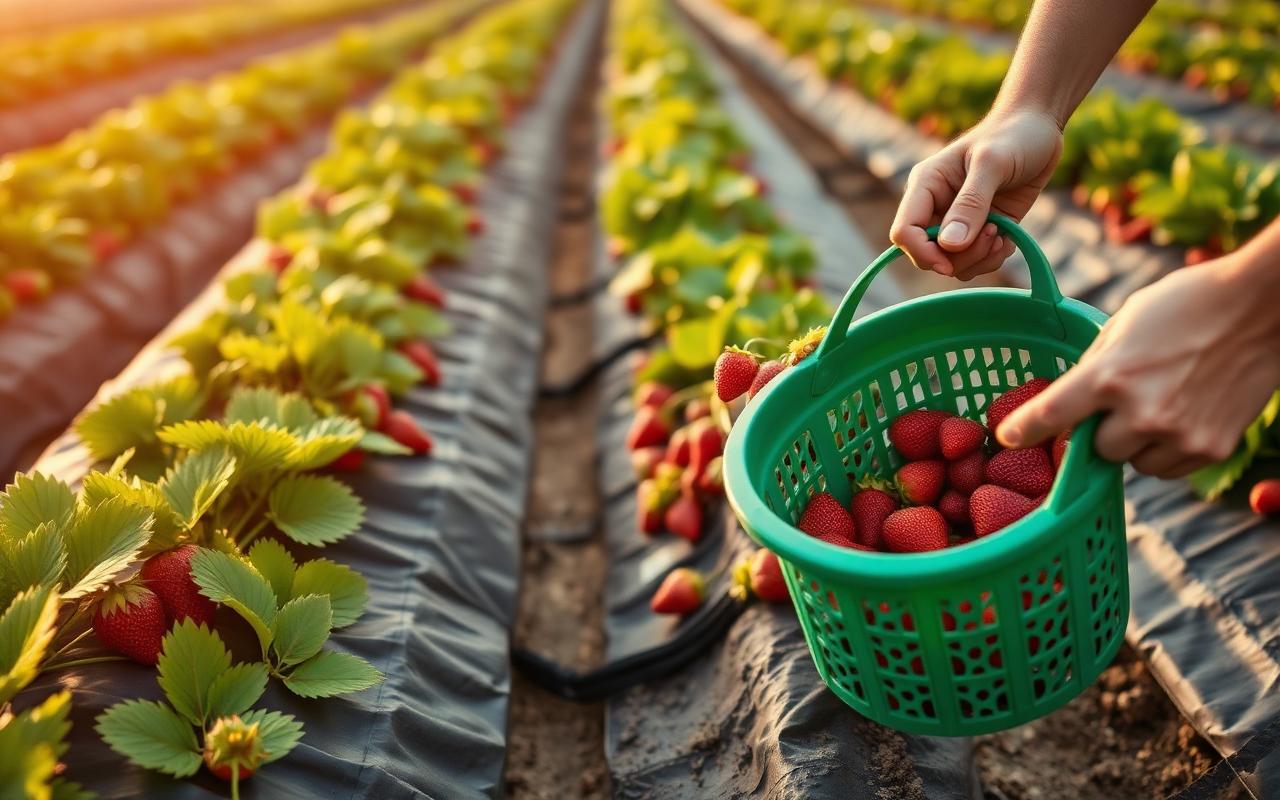
Strawberries are the highest-revenue-per-bed crop most small farms will ever grow, and the most punishing one to get wrong. A well-run plasticulture bed can return $8–$14 per linear foot in a single season. A neglected one turns into a grey mould nursery in three humid weeks. The difference is almost entirely decisions made before the first plant goes in the ground.
Choosing a production system
Three systems dominate small-farm strawberry production, and they are not interchangeable.
Annual plasticulture. Short-day (June-bearing) plugs set in late summer or early autumn on raised beds covered with black plastic mulch, drip tape underneath, harvested the following spring, then terminated. Yields run 0.7–1.2 lb per plant with plants spaced 12–14 inches in double rows. This is the highest-yield, highest-quality system, and the one to default to if your climate allows autumn planting.
Matted row. June-bearing crowns planted in spring on bare ground, runners allowed to fill a 18–24 inch band, harvested for three to five seasons. Lower establishment cost, lower fruit quality, far more weeding. Still the right call on cold sites where autumn plugs will not survive, or where labour is scarce and land is cheap.
Day-neutral annuals. Varieties such as Albion and Seascape flower regardless of daylength and crop from midsummer until frost. Yields per plant are lower, but fruit arrives when nobody else has strawberries, which is why day-neutrals routinely clear $6–$8 per pound at market against $3–$4 for peak-season June-bearers.
Most farms serving a weekly market do best running both: plasticulture June-bearers for the six-week spring surge that builds the customer list, and a smaller day-neutral block that keeps berries on the table through the summer.
Varieties that earn their bed space
Variety choice is regional, but a few reliable performers show up across most temperate small-farm trials.
- Chandler — the plasticulture benchmark in mild-winter regions. Large, glossy, excellent flavour, moderate disease resistance. Soft, so it does not ship, which is exactly why it belongs on a direct-market farm.
- Ruby June — earlier than Chandler by five to seven days, firmer, holds size late in the season. Earliness alone is worth a premium.
- Albion — the standard day-neutral. Firm, conical, consistently sweet, tolerant of Verticillium and crown rot.
- Seascape — a day-neutral with better heat tolerance than Albion and a slightly softer, more aromatic berry.
- Honeoye — a matted-row workhorse for cold climates: bulletproof winter hardiness, heavy early yields, tart flavour that suits jam more than fresh eating.
Buy certified disease-free plugs or crowns every time. Saving runners from your own beds carries anthracnose and Phytophthora forward at no saving worth counting.
Bed preparation and planting
Strawberries want a well-drained loam at pH 5.8–6.5, with 3% or more organic matter and no history of Verticillium hosts — tomatoes, potatoes, peppers, aubergines — in the previous three years. That rotation rule breaks more strawberry blocks than any pest.
Form beds 6–8 inches high and 28–30 inches wide on 5-foot centres. Height matters: raised beds warm faster in spring, drain during wet spells, and keep fruit off saturated soil. Lay one or two lines of drip tape at 8-inch emitter spacing on the bed surface, then pull black embossed plastic mulch tight over the top and bury the edges. Slack plastic flaps in wind, tears, and lets weeds through.
Punch holes on a staggered double row, 12–14 inches in-row and 12 inches between rows. Set plugs so the crown sits level with the soil surface — buried crowns rot, exposed crowns desiccate. Water in immediately and keep the root zone consistently moist for the first ten days while roots bridge into the bed.
Autumn-planted plugs need enough time to build four to six healthy leaves and a substantial crown before cold weather stops growth. Plant too late and you get small spring plants with two trusses instead of five; plant too early in a warm autumn and plants run to runner instead of crown. Your regional extension planting window exists for a reason.
Irrigation and fertigation
Under plastic, drip is the only sane delivery method, and it is doing two jobs: water and nutrition. Strawberries are shallow-rooted, with 80% of active roots in the top 8 inches. They cannot buffer a dry week.
Target roughly 1 to 1.5 inches of water per week during fruiting, split across three to five short irrigations rather than one long soak. A tensiometer or simple soil-moisture sensor set at 6 inches removes the guesswork: irrigate when tension reaches 15–20 centibars, stop before the bed goes saturated.
Fertigation schedule for annual plasticulture, broadly:
- Establishment (weeks 1–4): a balanced starter with phosphorus for root development, roughly 0.5 lb N per acre per day.
- Overwinter: nothing. Dormant plants take up almost no nutrients and winter fertigation just leaches.
- Spring green-up through first bloom: 0.75–1.0 lb N per acre per day, primarily calcium nitrate, which supports both leaf growth and fruit firmness.
- Harvest: maintain nitrogen at 0.5–0.75 lb per acre per day and add potassium — potassium nitrate or potassium sulphate — because fruiting removes far more K than N.
Leaf tissue tests at bloom and mid-harvest are cheap and will catch a boron or calcium deficiency long before you see misshapen fruit.
Pests, disease and the humidity problem
Nearly every strawberry disease of consequence is a moisture problem in disguise.
Botrytis (grey mould) infects at bloom and stays latent until the fruit ripens, which is why spraying rotten fruit accomplishes nothing. Manage it at flowering with airflow, wide bed spacing, careful nitrogen and, where permitted, a bloom-timed biological or fungicide application. Pick every two days in warm weather; a single overripe berry left in the row seeds the whole bed.
Anthracnose arrives on infected plugs and spreads by splashing water. Plastic mulch helps enormously by preventing soil splash. Rogue infected plants out of the field rather than walking past them repeatedly.
Spotted wing drosophila lays into ripening fruit from midsummer onward, making day-neutral blocks the more vulnerable planting. Monitor with apple-cider-vinegar traps, harvest on a tight two-day cycle, chill fruit immediately, and remove culls from the field entirely.
Two-spotted spider mite explodes in hot, dry, dusty conditions. Scout leaf undersides weekly; releases of Neoseiulus californicus at the first sign of stippling are effective and far cheaper than losing canopy in June.
Birds and deer. Bird netting on hoops over the bed pays for itself in one season on any block near woodland. Deer fencing is a whole-farm decision, but strawberries are one of the crops that force it.
Harvest, handling and shelf life
Strawberries do not ripen after picking. Harvest at full colour, in the cool of the morning, into shallow pint or quart containers — deep containers crush the bottom layer and turn a premium pack into a jam pack.
Field heat is the enemy of shelf life. A berry picked at 25 °C and left in the sun for two hours loses roughly half its post-harvest life. Move fruit to shade within 30 minutes and into cold storage at 0–2 °C with high humidity within two hours. A used reach-in cooler or a CoolBot-controlled insulated room costs a fraction of what spoilage costs over a season.
Never wash fruit before storage or sale. Surface moisture accelerates Botrytis and softens the berry.
The economics, honestly
Illustrative figures for a quarter-acre annual plasticulture block, roughly 4,000 plants:
- Plugs at $0.28 each: $1,120
- Plastic mulch, drip tape and fittings: $450
- Fertiliser and crop protection: $400
- Bed prep, fuel and amendments: $350
- Row cover and bird netting (amortised): $300
- Harvest labour, ~180 hours at $16: $2,880
- Total cost: roughly $5,500
At a conservative 0.8 lb per plant, that block yields 3,200 lb. Sold at farmers market in pints at an effective $5.50 per pound, gross revenue is around $17,600 — a net near $12,000 on a quarter acre, with harvest labour already paid. Wholesale at $2.75 per pound halves the gross and turns the same block into a marginal enterprise. Strawberries reward direct marketing more sharply than almost any other crop, and that is the single most important line in this budget.
Build a demand plan before you build the beds. Six weeks of concentrated June-bearer harvest can flood a small market. Pre-sell through a CSA add-on, a u-pick session, or a wholesale account for the surplus, and price value-added jam or frozen packs for the culls.
A realistic first year
Start with 500 to 1,000 plants, not 4,000. The learning curve is in the details — plug depth, irrigation timing, harvest cadence, cooling logistics — and every one of those is cheaper to learn on two beds. Keep a written record of planting date, first-bloom date, first-harvest date, weekly yields and every spray or amendment. That record is worth more in year two than any guide, including this one.
Key takeaways
- ◆Annual plasticulture gives the highest yield and fruit quality where autumn planting is possible.
- ◆Never plant strawberries after tomatoes, potatoes or peppers within three years - Verticillium destroys blocks.
- ◆Drip fertigation with calcium nitrate through bloom and potassium through harvest is the core nutrition programme.
- ◆Cool fruit to 0-2 degrees C within two hours of picking; field heat halves shelf life.
- ◆Direct marketing roughly doubles the return per pound compared with wholesale - build demand before you build beds.
Frequently asked questions
How many strawberries can I grow per acre?+
An annual plasticulture block runs about 16,000 plants per acre at 12-14 inch spacing, yielding roughly 0.7-1.2 lb per plant, or 11,000-19,000 lb per acre in a well-managed season.
Should I grow June-bearing or day-neutral strawberries?+
Grow both. June-bearers give a high-yield six-week spring surge that builds your customer list; day-neutrals crop through summer when nobody else has berries and command a higher price.
How long do strawberry beds last?+
Annual plasticulture beds are terminated after one harvest season for best quality. Matted row plantings are typically kept three to five years before yield and disease pressure force renewal.
Why are my strawberries rotting on the plant?+
Almost always Botrytis grey mould, which infects at bloom and shows at ripening. Improve airflow, avoid excess nitrogen, harvest every two days and never leave overripe fruit in the row.
Keywords
- growing strawberries for market
- strawberry plasticulture
- day-neutral strawberries
- strawberry yield per acre
- small farm strawberry production
Related reading
Market Gardening
Greenhouse Tomatoes: Building a Profitable Protected-Cropping Block
Variety choice, grafting, drip fertigation, pruning to a single leader, climate control and honest per-plant economics for growers building a profitable greenhouse tomato block.
August 5, 2026 · 8 min read
Market Gardening
CSA Farming: How to Structure a Profitable Vegetable Subscription
Learn how to build a profitable CSA vegetable subscription with expert tips on pricing, crop planning, logistics, and customer retention strategies.
July 19, 2026 · 7 min read
Market Gardening
Market Gardening: The First-Year Mistakes That Cost the Most
The pattern of expensive mistakes new market gardeners make in year one — and the small planning decisions that separate a viable second season from a shut-down.
July 1, 2026 · 8 min read