Homesteading
Rainwater Harvesting on the Homestead: Systems, Sizing and What It Actually Saves
A working guide to catchment, storage, filtration and delivery for homestead-scale rainwater harvesting — what the systems cost, what they save, and the mistakes that turn a $6,000 setup into a green swamp.

Published July 18, 2026 · 12 min read
A 2,000-square-foot roof in a region that gets 36 inches of annual rainfall sheds roughly 45,000 gallons per year. That is enough to irrigate a half-acre market garden, water a small flock of livestock and cover indoor use for a two-person household — if you can catch it, store it, and deliver it when the roof is dry. This guide is about designing that system so it actually works in year three, not just the summer you installed it.
Why homesteaders actually build these systems
Four motivations show up over and over. Understanding which of them is driving your build determines the design.
- Off-grid or edge-of-grid living where drilling a well is expensive or impossible. In parts of Hawaii, the Texas Hill Country, mountain lots in Colorado and much of rural Appalachia, catchment is the primary water source for tens of thousands of homes.
- Irrigation resilience during summer drawdowns. A garden that loses municipal-water access for two weeks in August can survive on 3,000–8,000 gallons of stored rainfall if the system was sized for it.
- Water quality preference. Rainwater is soft, has no chlorine and requires no softener — a real quality-of-life upgrade for households on hard well water.
- Cost. In regions with expensive utility water or seasonal restrictions, a $6,000 catchment system can pay back in 4–8 years and continues delivering for 25+.
The catchment math in one paragraph
Every rainwater system starts with one equation: gallons captured = catchment area (sq ft) × rainfall (inches) × 0.623 × capture efficiency. Capture efficiency for a metal or asphalt-shingle roof with clean gutters runs 0.75–0.90; older wood-shake or debris-heavy roofs run 0.55–0.70. A 2,000-square-foot roof in a 36-inch rainfall region at 0.85 efficiency captures 2,000 × 36 × 0.623 × 0.85 = 38,127 gallons per year. That number is your ceiling — everything after this is about not losing what the roof already gave you.
Sizing storage for a real climate, not an average one
The most common sizing mistake is designing for average annual rainfall. Averages hide the gap that matters — the longest stretch between meaningful rains, which is when you draw the tank down. Two questions replace the average:
- What is the longest dry stretch in a normal year? Pull 10 years of monthly rainfall from your nearest NOAA station. Find the longest run of months with under 0.5 inches of rain. That is your design gap.
- What is your daily demand during that gap? Household indoor use runs 40–80 gallons per person per day (lower with efficient fixtures). Garden irrigation runs 0.5–0.75 gallons per square foot per week in peak summer. Livestock: chickens 0.25 gal/day each, goats 2–3 gal/day, a milk cow 20–30 gal/day.
Multiply daily demand by the dry-gap length. That is your minimum working storage. Add 20% for margin. A two-person household with a 1,500-square-foot garden and a small chicken flock in a climate with a 90-day dry summer typically lands at 8,000–12,000 gallons of storage — well beyond what a couple of 55-gallon rain barrels can hold. This is where most beginner systems fail: barrels are cute, cisterns are the answer.
The five components every system needs
- Catchment surface. Metal roofing is best (highest efficiency, cleanest runoff, longest life). Asphalt shingles are workable for non-potable use. Avoid treated wood shakes, moss-covered roofs and roofs coated with anti-mold chemicals.
- Gutters and downspouts, sized generously (6-inch K-style gutters handle 2-inch/hour rain events on most residential roofs; 5-inch is the minimum). Add leaf screens and a first-flush diverter that dumps the first 10–20 gallons of every storm — the runoff that carries roof dust, bird droppings and pollen.
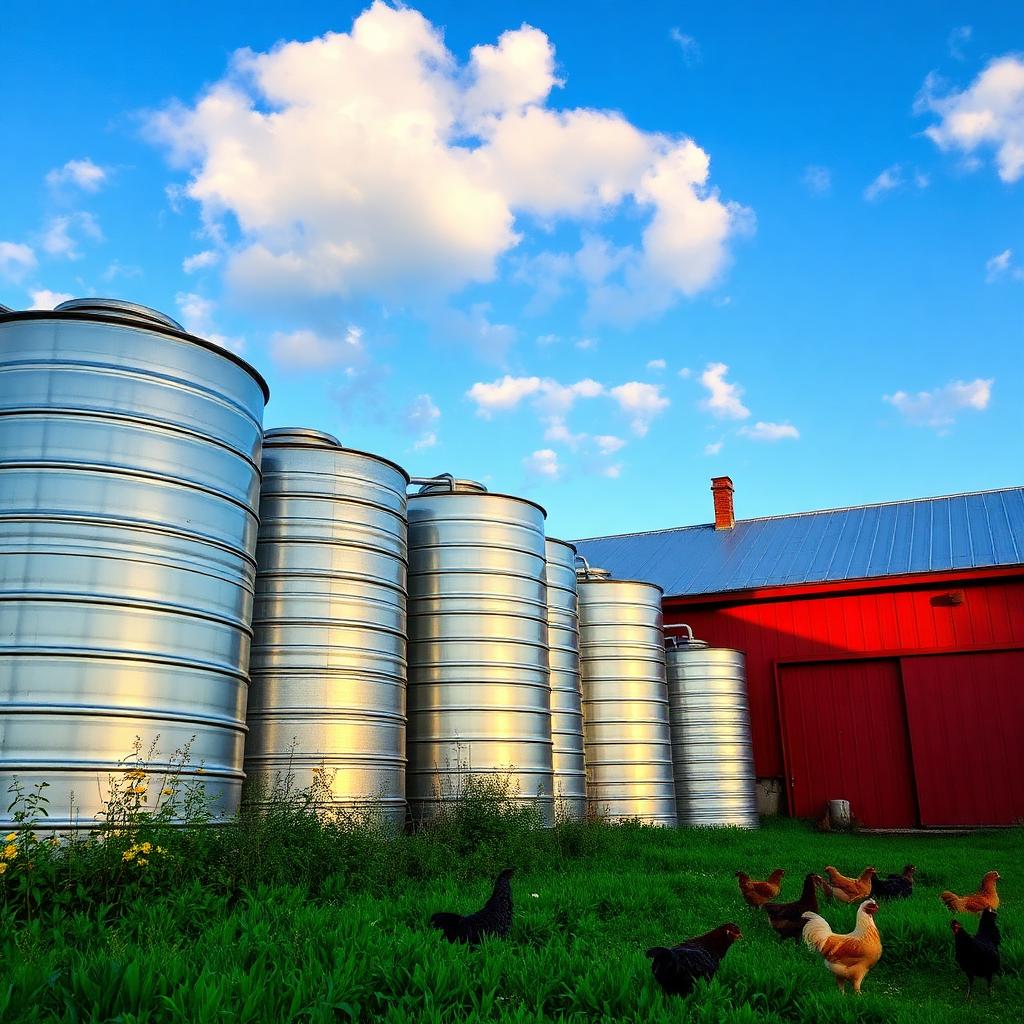
- Storage. Options in order of typical use: polyethylene tanks (best cost/durability balance, opaque UV-stable versions last 20+ years, $0.50–$1.00 per gallon of capacity installed), galvanized steel tanks (30+ year life, $1.50–$2.50/gallon, distinctive look), poured concrete cisterns (50+ year life, $2.50–$5.00/gallon, best for buried potable systems), and IBC totes (cheap at $80–$150 each but only appropriate for non-potable and short-term use). Rain barrels have a place — flushing a raised bed with rainwater — but they are not a homestead system.
- Delivery. Gravity feed works if your tank is at least 10 feet above your point of use, which is rare. Most systems use a shallow-well jet pump ($400–$800) or a demand pump with pressure tank ($600–$1,200) sized to deliver 8–12 gallons per minute at household pressure (40–60 psi).
- Overflow. Every tank must have a routed overflow that drains to a rain garden, swale or infiltration basin at least 10 feet from the foundation. An unrouted overflow soaks the tank pad, undermines the base and eventually tips a full tank.
Potable vs non-potable — where the code line falls
Rainwater for garden, livestock and outdoor use is legal and unregulated in almost every state. Rainwater for indoor use falls into three buckets by state:
- Fully permitted — Texas, Hawaii, Oregon, Washington, Arizona and about a dozen others allow potable rainwater with a permitted treatment train.
- Permitted with restrictions — many states allow rainwater for indoor non-potable use (toilets, laundry) but require utility water for kitchen and bath fixtures.
- Prohibited or heavily restricted — a shrinking list, but check your county building department before designing for indoor use.
A code-compliant potable treatment train has four stages: (1) 20-micron sediment filter, (2) 5-micron sediment filter, (3) activated carbon filter, (4) UV sterilizer sized for your peak flow rate. Budget $600–$1,200 for the filtration stack plus $150–$300 per year in replacement filters and UV bulbs.
What a working system actually costs
Three realistic build tiers on a mid-sized homestead:
- Non-potable irrigation only, 2,500-gallon poly tank, gravity delivery to a garden 8 feet below the tank: $1,800–$3,000 in materials, one weekend of labor.
- Non-potable irrigation and livestock, 5,000-gallon poly tank, pump and pressure tank, buried 1-inch supply line: $4,500–$7,000 in materials, 3–5 days of labor or one week with a hired excavator.
- Full potable household + garden, 10,000-gallon buried concrete cistern, complete treatment train, integration with existing plumbing: $18,000–$32,000 turnkey; DIY buildable for $12,000–$18,000 if you can lay pipe and handle the excavation.
Payback for the irrigation-only system in a region with $8/1,000-gallon municipal water and a working garden runs 5–8 years. Payback for the full potable system is almost never about dollars per gallon — it is about being able to build where a well is not viable.
The mistakes that turn a cistern into a swamp
- Skipping the first-flush diverter. The first flush of every rain event carries the dirtiest water off the roof. Systems without a diverter accumulate sediment and bird waste in the tank; systems with one stay clear for years.
- Translucent or above-ground tanks in sunlight. Any light reaching the water grows algae. Use opaque tanks or shade them; bury the tank if you can afford to.
- Undersized inlet fittings. A single 3-inch storm on a 2,000-square-foot roof produces 3,000+ gallons in a few hours. If your tank inlet cannot pass that volume, the overflow at the gutter dumps most of your yield onto the ground.
- No maintenance schedule. Clean gutters twice a year. Inspect the first-flush diverter every quarter. Replace sediment filters on a fixed schedule, not "when they look bad." A homestead water system is not install-and-forget.
- Assuming rainwater will fully replace a well or municipal connection. In most climates, catchment is a supplement or a backup — sized correctly, it covers 60–95% of demand. Designing for 100% means either drastically higher storage or accepting real risk in a dry year.
Done properly, a rainwater system is one of the highest-return infrastructure investments a homestead makes — a piece of the property that quietly delivers value for 25 years while the rest of the operation churns through equipment. Done poorly, it is a green tank that mosquitoes love and the family avoids. The difference is almost entirely in the details above.
Key takeaways
- ◆The catchment equation: catchment area × rainfall × 0.623 × efficiency — this is the ceiling every system works within.
- ◆Design storage for the longest dry gap in a normal year, not for average annual rainfall.
- ◆A working system needs five components: catchment, gutters with first-flush diverter, storage, delivery, and a routed overflow.
- ◆Potable use requires sediment, carbon and UV treatment and usually a county permit — non-potable garden and livestock use rarely does.
- ◆First-flush diversion, opaque tanks and a real maintenance schedule are the difference between a 25-year asset and a mosquito farm.
Frequently asked questions
How much roof area do I need to be worth it?+
For garden irrigation, anything over about 800 square feet of catchment in a region with 25+ inches of annual rainfall makes a meaningful system. Below that, you can still capture usefully into a couple of 500-gallon tanks, but the yield rarely justifies a full pumped system.
Can I use rainwater for drinking without treatment?+
No. Untreated roof runoff carries bird droppings, roof dust, pollen and airborne bacteria. Rainwater intended for drinking must run through sediment filtration, carbon filtration and UV sterilization at minimum, and the system should be built and permitted as potable from the start.
Do I need a permit to install a rainwater system?+
For garden and livestock use, almost never. For any system connected to indoor plumbing — even for toilets and laundry — you almost always need a permit and inspection. Check with your county building department before running pipe into the house.
What happens to the system in freezing climates?+
Above-ground tanks in cold-winter regions must either be drained before hard freeze or insulated with heat trace on the outlet line and a submerged tank heater. Buried tanks below the frost line stay usable year-round; that is the primary reason most northern potable systems bury the cistern.
Keywords
- rainwater harvesting
- homestead water system
- rainwater collection sizing
- rain barrel vs cistern
- off-grid water storage
Related reading
Homesteading
Pasture-Raised Poultry: The Economics of a 200-Bird Flock
A transparent enterprise budget for a 200-bird pastured broiler operation — feed, infrastructure, labor, processing, sales and the actual take-home margin per bird.
July 13, 2026 · 12 min read
Homesteading
Starting a Backyard Homestead: The Realistic First Year
A grounded, non-romantic guide to your first year of homesteading — what actually works on a quarter-acre, in what order, and where new homesteaders most often burn out.
July 5, 2026 · 9 min read
AgTech & Precision Farming
Smart Irrigation for Small Farms: Systems That Pay Back
Drip, sensors, and scheduling that actually work on 1–20 acres. Real system designs, costs, and the metrics that decide whether the investment pays for itself.
June 18, 2026 · 9 min read