Soil Health
The Soil Microbiome: What Every Farmer Should Actually Know About the Life Underground
Bacteria, fungi, protozoa and nematodes run the nutrient cycle beneath every field. Here is what they actually do, how to read a soil biology test and the four practices that reliably feed them.

Published July 17, 2026 · 13 min read
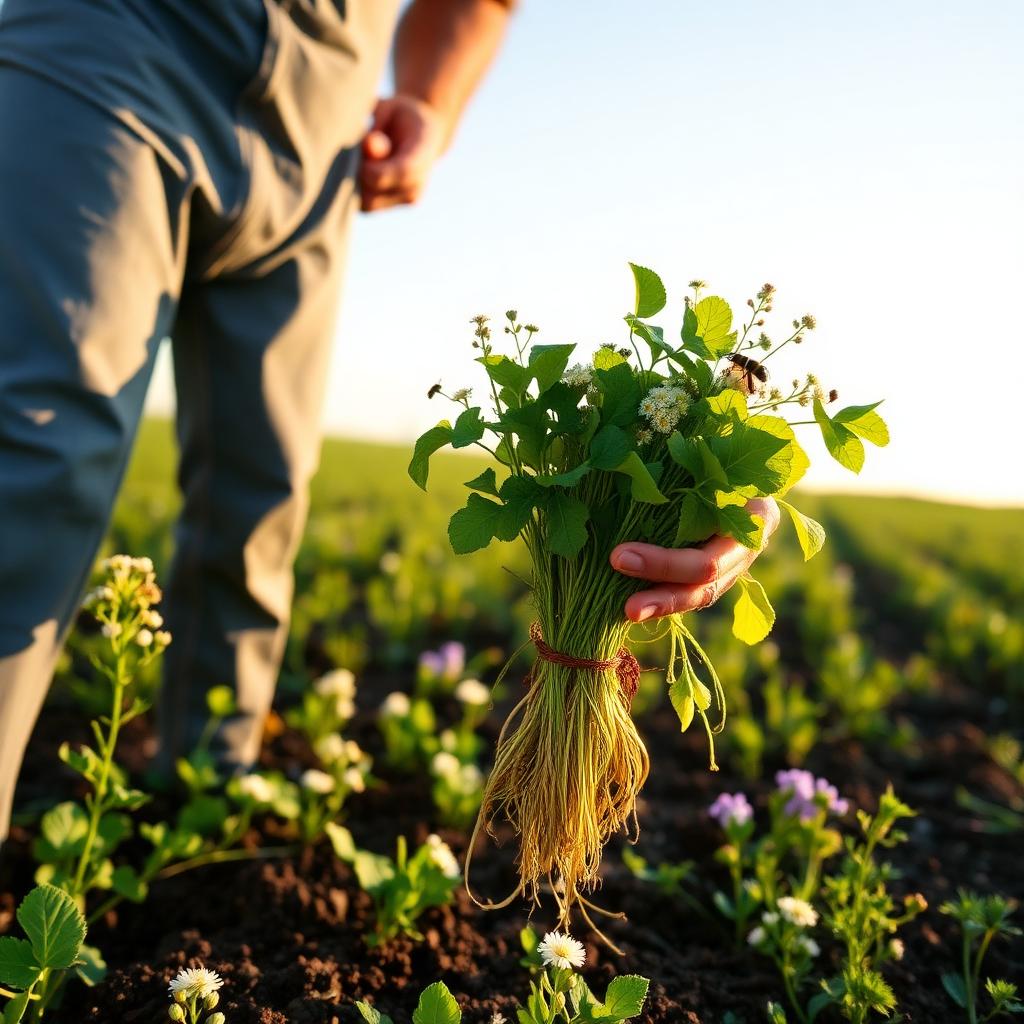
Every pound of healthy topsoil contains more living organisms than there are humans on Earth. That is not a metaphor — it is the reason a well-managed field can grow a strong crop on 30% less synthetic nitrogen while a depleted one cannot grow the same crop on double the fertilizer. This guide is about what those organisms do, how to know whether yours are working, and the small number of practices that decide the outcome.
Who actually lives in the soil
The soil food web is layered. Understanding the layers is the difference between shotgun-buying biological products and knowing what you are managing.
- Bacteria — the most abundant organisms, at roughly 1 billion cells per gram of healthy topsoil. Most are decomposers; a smaller fraction fix atmospheric nitrogen (rhizobia in legume nodules, free-living azotobacter) or solubilize phosphorus.
- Fungi — measured by hyphal length, not count. A healthy grassland or no-till field carries 100–500 meters of fungal hyphae per gram. The two families that matter most are saprophytic fungi (decompose crop residue and stabilize carbon) and arbuscular mycorrhizal fungi or AMF (form partnerships with 80% of crop plants, trading soil phosphorus and water for plant sugars).
- Protozoa — single-celled predators of bacteria. Their job is nitrogen release: when a protozoon eats a bacterium, it excretes the excess nitrogen as plant-available ammonium. This is where much of the nitrogen actually available to a crop comes from in low-input systems.
- Nematodes — microscopic roundworms. Most are beneficial (bacterial feeders, fungal feeders, predators of pest nematodes). A small minority (root-knot, cyst) are the pests farmers usually think of first.
- Arthropods and earthworms — the macrofauna. Earthworms alone can move 20 tons of soil per acre per year and their castings carry 5–10× the plant-available nutrients of the surrounding soil.
What the microbiome does for a crop
Four jobs matter operationally. Every claim biology-adjacent products make maps back to one of them.
- Nutrient cycling. A well-fed microbiome mineralizes 40–120 lb/acre of nitrogen per year from soil organic matter and residues — free, if the biology is intact. On a depleted soil, that number is 10–30 lb.
- Phosphorus access. Most soil phosphorus is bound and not plant-available. AMF fungi grow into and mine that pool, extending a plant's effective root surface area 10–100 fold and delivering phosphorus the roots cannot reach.
- Aggregation and water infiltration. Fungal hyphae and bacterial glues bind soil particles into aggregates. That aggregate structure is what lets a healthy field infiltrate 3–6 inches of rain per hour while a compacted neighbor infiltrates half an inch.
- Disease suppression. A diverse microbial community competitively excludes many pathogens; specific groups (Trichoderma, Pseudomonas fluorescens) actively antagonize root disease organisms.
Reading a soil biology test without getting fooled
Two tests dominate the market, and they measure different things.
PLFA (phospholipid fatty acid analysis) — a lab-based fingerprint of the living microbial community at the time of sampling. It gives you total microbial biomass and rough ratios of bacteria to fungi and of AMF to saprophytes. Cost: $40–$75 per sample. This is the useful, comparable test — take it at the same time of year each season to track direction.
Direct microscopy / Soil Food Web assays — a trained microscopist counts and measures organisms under a microscope. Rich in detail but heavily dependent on the analyst; results between labs are often not comparable. Useful as a diagnostic once, not as an annual monitoring tool.
Two numbers matter more than any other on a PLFA report:
- Total microbial biomass (ng/g). Under 1,500 = depleted. 1,500–3,500 = typical row-crop range. 3,500+ = well-fed.
- Fungi-to-bacteria ratio. Row-crop soils typically sit at 0.1–0.3. Moving toward 0.5–0.8 is the operational goal — it correlates with lower nitrogen loss, better aggregate stability and improved carbon retention.
The four practices that reliably feed the microbiome
Every field trial that has measurably improved soil biology in under five years has used some combination of these four levers. There is no fifth.
- Keep a living root in the ground as many months of the year as possible. Living roots exude sugars (up to 30% of a plant's photosynthetic output) that directly feed the rhizosphere community. A field that grows a cash crop for four months and lies bare for eight cannot build biology; a field with an overwintering cover crop feeds the microbiome year-round.
- Reduce tillage. A single moldboard-plow pass destroys 60–90% of fungal hyphae and disrupts aggregate structure it took years to build. Strip-till or no-till preserves the physical architecture the microbiome lives in.
- Diversify the rotation. Different plant families feed different microbial communities. A corn-soy-wheat rotation with a cover crop mix supports 3–4× the microbial diversity of continuous corn.
- Return carbon. Composted manure, cover-crop residue, chopped straw — any stable carbon source is food for the decomposer community. The most consistent biological gains in on-farm trials come from combining reduced tillage with a 4–8 ton/acre application of finished compost every 2–3 years.
Do biological inoculants work?
Short honest answer: some do, most do not measurably, and it depends heavily on the soil you are applying them to.
Well-established beneficial products:
- Rhizobium inoculant on legumes planted in fields that have not grown that legume in 3+ years — reliable, cheap, near-universally profitable.
- AMF inoculant on transplanted vegetables going into soil with a history of tillage or fumigation — often profitable in high-value crops (tomatoes, peppers, brassicas). Rarely profitable in field corn or soybeans, which already carry robust native AMF populations.
Broad-spectrum "microbial soup" biostimulants — mixed bacterial and fungal blends sold in gallon jugs — show inconsistent results in university trials. They do not fix a soil with the wrong management; they can help a well-managed soil marginally. Treat them as a tuning tool, not a foundation.
Signs you are winning
Field indicators that biology is improving, before the PLFA test confirms it:
- A spade of soil crumbles into pea-sized aggregates rather than clods or dust.
- Earthworm counts exceed 10 per square foot in the top 6 inches.
- Cover-crop residue on the surface visibly decomposes within one season rather than persisting for two.
- After a 1-inch rain, water pools for under 10 minutes on a level field.
- Crop roots pull up with visible white fungal threads clinging to them.
What better biology is worth per acre
The numbers that consistently show up in five-year regenerative transitions:
- Nitrogen fertilizer reduction: 20–40 lb/acre after year three, worth $12–$25/acre at current urea prices.
- Phosphorus fertilizer reduction: 15–30% starter cut once mycorrhizal populations rebuild, worth $8–$15/acre.
- Water infiltration: yield protection in dry years worth 5–15 bu/acre of corn in stress years.
- Disease pressure: reduced fungicide passes, typically saving $15–$25/acre in high-pressure years.
Combined, the annual value of a functioning microbiome on a corn-soybean field runs $35–$75 per acre before counting yield stability. That is the economic case for treating the biology as an asset — one you feed, protect from tillage, and let build.
Key takeaways
- ◆Healthy topsoil contains billions of bacteria, hundreds of meters of fungal hyphae and diverse predators per gram — all doing crop-relevant work.
- ◆PLFA testing gives comparable, useful numbers; total biomass and fungi-to-bacteria ratio are the two metrics that matter.
- ◆The only practices that reliably build biology are living roots year-round, reduced tillage, diverse rotations and returned carbon.
- ◆Rhizobium and AMF inoculants have clear use cases; broad-spectrum microbial products do not substitute for management.
- ◆A well-fed microbiome is worth $35–$75/acre/year in reduced inputs and yield stability on a typical row-crop farm.
Frequently asked questions
How fast can I actually change soil biology?+
Measurable PLFA change usually appears in 18–36 months once you combine cover cropping, reduced tillage and diverse rotation. Field-visible changes (aggregation, earthworm counts, infiltration) often show in one season. Full recovery of severely depleted soils takes 5–8 years.
Is a soil biology test worth the money on a commodity farm?+
One baseline PLFA test is almost always worth it — it tells you where you are starting. Repeat testing is worth it if you are actively changing management; if practices are static, biology results will be static and the test is not adding decisions.
Do I need to stop all synthetic fertilizer to grow biology?+
No. High-rate anhydrous ammonia and repeated broadcast urea suppress biology, but moderate banded rates alongside cover crops and reduced tillage still permit strong biological gains. The compounds that most damage biology are broad-spectrum soil fumigants and repeated fungicide seed treatments; nitrogen and phosphorus at agronomic rates are compatible with a healthy microbiome.
Can biology fix a compaction problem on its own?+
Partly. Deep-rooted cover crops (tillage radish, cereal rye) plus active biology can address surface and shallow compaction in 2–3 seasons. Sub-soil compaction from heavy equipment on wet soil often needs mechanical fracturing (one careful deep-till pass) combined with biological rebuilding — biology alone will not lift a plow pan in a reasonable timeframe.
Keywords
- soil microbiome
- soil biology test
- mycorrhizal fungi farming
- soil food web
- regenerative soil biology
Related reading
Regenerative Farming
No-Till Transition: What Actually Happens in Years One Through Five
An honest, year-by-year account of what to expect when a conventional farm converts to no-till — yield dips, weed shifts, equipment costs and the point where the system finally pays.
July 14, 2026 · 13 min read
Regenerative Farming
Cover Crop Rotation Planning: A Season-by-Season Playbook
Design a cover-crop rotation that actually fits your cash crops, climate and equipment. A working agronomist's playbook with species mixes, seeding rates and termination timing.
June 2, 2026 · 10 min read

Soil Health
Building Healthy Soil: A Practical, Working-Farm Guide
How real farms build living, productive soil — a field-tested guide to soil biology, organic matter, cover crops and testing you can actually use this season.
May 14, 2026 · 12 min read